This is a great piece by the Governor of Massachusetts that appeared in the Washington Times. Sent to us via email.
For more on Mitt Romney click here.
Reforming education
By Mitt Romney
April 10, 2006 - Washington Times OpEd
I was in high school when Sputnik happened. Russia's lead in space frightened us. It also woke us up. President Kennedy issued a call to boost science and math education, to produce more engineers. His vision: Put a man on the moon. America, as always, rose to the occasion.
One could argue that there have been quite a few Sputniks lately, but that we haven't noticed. Tom Friedman's flat world is tilting toward Asia, taking investment and jobs. Of 120 new chemical plants worldwide with over $1 billion in capital, 50 are planned for China, only one for the United States. Bill Gates says Microsoft's best new ideas are coming from his Asian team. And last year, America bought $160 billion more from China than China bought from us. America is still way ahead, but in the words of Will Rogers: "Even if you're on the right track, if you don't move, you'll get run over." It's time we get moving, starting with education. First, close the Excellence Gap. American 15-year-olds rank 24th out of 29 OECD countries in math literacy and 19th in science. Fifteen years ago, the United States and Asia produced about the same number of Ph.D.'s in math and physical science: 4,700 a year. Today, we graduate 4,400; Asia graduates 24,900. Second, close the Achievement Gap. Failing urban schools are a dead end for too many minority children. This is the civil rights issue of our generation.
How to close the education gaps? The teacher's unions have their answers: simply spend more money and hire more teachers for smaller classroom size. But the data show that those are not the answers at all. Massachusetts tests our kids regularly; when studentproficiencyis matched with classroom size and per-pupil spending, there is absolutely no relationship. In fact, the district with the highest per-pupil spending in our state -- almost $19,000 per student -- is in the bottom 10 percent of our state in student proficiency.
We found our education prescription by interviewing parents, teachers and principals, studying actual data, mining lessons from successful districts and charter schools, and digesting the recommendations from commissions and experts. Here are some of the real answers:
1) Make teaching a true profession. The 19th-century industrial labor-union model doesn't make sense for educating children. Teachers aren't manufacturing widgets. Better teachers should have better pay, advancement opportunities and mentoring responsibilities. Better pay should also accompany the most challenging assignments -- needed specialties like math and science, advanced placement skills and extra effort.
2) Let the leaders lead. Superintendents and principals must have authority to hire, deploy resources, assign mentors and training, and remove nonperformers. Seniority cannot trump the needs of our children.
3) Measure up. Over union objections, Massachusetts implemented standardized testing and a mandatory graduation exam. With measurement, we finally see our successes and failures and can take corrective action. Without measurement, we were blind.
4) Let freedom ring. When parents, teachers and kids are free to choose their school, everyone benefits. Charter schools free of union restraints and, yes, even home schools, teach lessons we can apply to improve standard public schools.
5) Pull in the parents. Teachers tell us that the best predictor of student success is parental involvement. For our lowest-performing schools, I've proposed mandatory parental preparation courses. Over two days, parents learn about America's education culture, homework, school discipline, available after-school programs, what TV is harmful or helpful and so on. And for parents who don't speak English, help them understand why their child's English immersion in school is a key to a bright future.
6) Raise the bar. Our kids need to be pushed harder. Less about self-esteem; more about learning. I have proposed advanced math and science schools for the very brightest (the one we have is a huge success, but we need more); advanced placement in every high school, more teachers with serious science and math credentials, and laptop computers for every middle- and high-school student. We've also added science as a graduation exam requirement, in addition to math and English.
These ideas should sound familiar -- they turn up in virtually every unbiased look at education. The opposition comes from some teachers unions. They fight better pay for better teachers, principal authority, testing and standards, school choice and English immersion. With their focus on themselves and their members, they have failed to see how we have failed our children. But that will change as testing produces data and data debunks the myth that more and more spending is the answer.
A continuing failure to close the excellence and achievement gaps would have catastrophic consequences, for individual human lives left short of their potential, and for our nation. Students around the world are racing ahead of ours. If we don't move, we'll become the France of the 21st century, starting as a superpower and exiting as something far less. Education must be one of our first priorities, as it was when Sputnik was launched the last time. We succeeded before. We will do it again.
Mitt Romney is governor of Massachusetts.
Monday, April 10, 2006


Sunday, April 09, 2006
Wall Street Journal-Courts Flunk the Civics Test
The following article was sent to us by our finance guy Pete Speer and appeared in the April 8th edition of the Wall Street Journal.
For a review and information to order Mr. Sandler and Mr. Schoenbrod book go to Amazon.com.
Wall Street Journal
Courts Flunk the Civics Test
By ROSS SANDLER and DAVID SCHOENBROD
April 8, 2006; Page A9
On March 23, a New York appellate court ordered the state legislature to provide an additional $4.7 billion for operating the New York City schools, plus another $9.2 billion for construction. These are immense sums, even in the Empire State. The advocacy group that brought the suit, Campaign for Fiscal Equity, declared the court's decision would "get real action" because the legislature must "come up with a solution now, right now." This was good spin, but it's not true.
Contrary to a widespread misconception, courts have no power to force a state legislature to appropriate money; nevertheless the ersatz order, coming as it did in the final days of the state's budget process, could tilt the legislators towards more spending. This is apparently what is happening in Albany, where, in a partial tip of their hats to the court, legislators authorized $11.2 billion in new debt to pay for school construction in New York City.
And what was pulled off in Campaign for Fiscal Equity, Inc. v. New York seems to be part of a pattern. Last July in Kansas a similarly timed judicial decision prodded its state legislature to pony up a hefty increase in school funding. This year Texas is under a June 1 deadline to change the source of school funding. Before the scam spreads further, it's time to lay it bare.
In New York, the courts found that the government is violating a state constitutional clause that the legislature "shall provide for the maintenance and support of a system of free common schools, wherein all the children of the state may be educated." The Kansas case was to enforce a similar clause. That most children in New York City and elsewhere in the state are not getting much of an education is not the question. What to do about it is.
Plausible suggestions include freeing the schools from rigid union contracts and bureaucratic procedures that make it all but impossible to fire incompetent teachers, reward good ones and remove disruptive students from the classroom. Other potential solutions include more charter schools and vouchers. One strand of thinking relates school failure to cultural norms rather than lack of money. In New York City, spending per pupil is among the highest in the nation, $13,400, and the educational results among the worst. The plaintiffs chose, however, to focus on the solution -- more money -- that delights teacher union allies. The courts played along.
Most people assume that the legislature must cough up the cash because courts have the power of contempt, which allows them to punish those who disobey their orders. In the school case, however, the courts can't punish anyone. State legislators are not defendants in this case, and even if they were, they can't be punished because they are immune from suit. The state's treasury is immune because the court lacks authority to appropriate more funds and can't fine the state for the legislature's unwillingness to do so. The remaining defendants are officials, including Gov. George Pataki. They can't be held in contempt for failing to produce the money because they are powerless under the state constitution to spend money the legislature has not appropriated.
Longstanding impediments to coercing legislators and governors have never stopped courts from nullifying statutes that violate constitutional rights by, for example, segregating schools, or suppressing free speech. But courts rightly have a tougher time when they want to exercise the legislature's power of the purse.
There are, to be sure, cases where courts have indirectly pressured legislators to spend more. The leading one was in New Jersey, in 1976. After the state Supreme Court found that the state had violated a constitutional requirement that all school districts have equal per-pupil funding -- and the legislature failed to give more money to the poorer districts -- the court ordered state officials to close all the schools until the legislature equalized spending. Faced with that prospect the legislature passed an income tax to raise the extra money.
The New Jersey court argued that its job was to vindicate the constitutional right to equal spending and, if the legislature would not achieve that result by increasing spending, the court would get it done by reducing spending for everyone to zero. The argument has a certain cold logic, but it's a nonstarter in New York and Kansas, where the right being enforced is to a sound basic education.
If a New York court closed the schools, it would be the judges who violated the state constitutional right, by denying any education to all students. That would undercut the only leg the court has to stand on, the rule of law. Nonetheless, when the Kansas court raised the question of whether it should close the schools, the threat was enough to pry some money from the legislature.
New York's high court made a grave mistake when the judges transferred the power to decide what is a sound basic education from the legislators to themselves. Assuming it is too late to admit its error, the court should stick to issuing a declaratory judgment that the state does not deliver a constitutionally adequate education rather than ordering the legislature to do anything. This, as it happens, is precisely the position urged by both Gov. Pataki as defendant, and his counsel, Attorney General Eliot Spitzer.
The coercive force behind such a declaratory judgment would come from all those who want to improve the schools, including New York City Mayor Michael Bloomberg, who demanded and got responsibility for the city's schools, and the voters of the state, for whom there is no more important issue.
When courts claim that they have power to make legislatures spend more to vindicate a constitutional right to basic education, they tamper with a basic tenet of our democracy -- no taxation without representation. Voters are entitled to hold political officials accountable for the taxes they levy, the money they spend, and the education they produce. When judges pretend that legislators are their marionettes, the legislators can escape accountability, but only if the voters are fooled. They shouldn't be.
Messrs. Sandler and Schoenbrod are professors at New York Law School and authors of "Democracy by Decree: What Happens When Courts Run Government" (Yale University Press, 2003).
For a review and information to order Mr. Sandler and Mr. Schoenbrod book go to Amazon.com.
Wall Street Journal
Courts Flunk the Civics Test
By ROSS SANDLER and DAVID SCHOENBROD
April 8, 2006; Page A9
On March 23, a New York appellate court ordered the state legislature to provide an additional $4.7 billion for operating the New York City schools, plus another $9.2 billion for construction. These are immense sums, even in the Empire State. The advocacy group that brought the suit, Campaign for Fiscal Equity, declared the court's decision would "get real action" because the legislature must "come up with a solution now, right now." This was good spin, but it's not true.
Contrary to a widespread misconception, courts have no power to force a state legislature to appropriate money; nevertheless the ersatz order, coming as it did in the final days of the state's budget process, could tilt the legislators towards more spending. This is apparently what is happening in Albany, where, in a partial tip of their hats to the court, legislators authorized $11.2 billion in new debt to pay for school construction in New York City.
And what was pulled off in Campaign for Fiscal Equity, Inc. v. New York seems to be part of a pattern. Last July in Kansas a similarly timed judicial decision prodded its state legislature to pony up a hefty increase in school funding. This year Texas is under a June 1 deadline to change the source of school funding. Before the scam spreads further, it's time to lay it bare.
In New York, the courts found that the government is violating a state constitutional clause that the legislature "shall provide for the maintenance and support of a system of free common schools, wherein all the children of the state may be educated." The Kansas case was to enforce a similar clause. That most children in New York City and elsewhere in the state are not getting much of an education is not the question. What to do about it is.
Plausible suggestions include freeing the schools from rigid union contracts and bureaucratic procedures that make it all but impossible to fire incompetent teachers, reward good ones and remove disruptive students from the classroom. Other potential solutions include more charter schools and vouchers. One strand of thinking relates school failure to cultural norms rather than lack of money. In New York City, spending per pupil is among the highest in the nation, $13,400, and the educational results among the worst. The plaintiffs chose, however, to focus on the solution -- more money -- that delights teacher union allies. The courts played along.
Most people assume that the legislature must cough up the cash because courts have the power of contempt, which allows them to punish those who disobey their orders. In the school case, however, the courts can't punish anyone. State legislators are not defendants in this case, and even if they were, they can't be punished because they are immune from suit. The state's treasury is immune because the court lacks authority to appropriate more funds and can't fine the state for the legislature's unwillingness to do so. The remaining defendants are officials, including Gov. George Pataki. They can't be held in contempt for failing to produce the money because they are powerless under the state constitution to spend money the legislature has not appropriated.
Longstanding impediments to coercing legislators and governors have never stopped courts from nullifying statutes that violate constitutional rights by, for example, segregating schools, or suppressing free speech. But courts rightly have a tougher time when they want to exercise the legislature's power of the purse.
There are, to be sure, cases where courts have indirectly pressured legislators to spend more. The leading one was in New Jersey, in 1976. After the state Supreme Court found that the state had violated a constitutional requirement that all school districts have equal per-pupil funding -- and the legislature failed to give more money to the poorer districts -- the court ordered state officials to close all the schools until the legislature equalized spending. Faced with that prospect the legislature passed an income tax to raise the extra money.
The New Jersey court argued that its job was to vindicate the constitutional right to equal spending and, if the legislature would not achieve that result by increasing spending, the court would get it done by reducing spending for everyone to zero. The argument has a certain cold logic, but it's a nonstarter in New York and Kansas, where the right being enforced is to a sound basic education.
If a New York court closed the schools, it would be the judges who violated the state constitutional right, by denying any education to all students. That would undercut the only leg the court has to stand on, the rule of law. Nonetheless, when the Kansas court raised the question of whether it should close the schools, the threat was enough to pry some money from the legislature.
New York's high court made a grave mistake when the judges transferred the power to decide what is a sound basic education from the legislators to themselves. Assuming it is too late to admit its error, the court should stick to issuing a declaratory judgment that the state does not deliver a constitutionally adequate education rather than ordering the legislature to do anything. This, as it happens, is precisely the position urged by both Gov. Pataki as defendant, and his counsel, Attorney General Eliot Spitzer.
The coercive force behind such a declaratory judgment would come from all those who want to improve the schools, including New York City Mayor Michael Bloomberg, who demanded and got responsibility for the city's schools, and the voters of the state, for whom there is no more important issue.
When courts claim that they have power to make legislatures spend more to vindicate a constitutional right to basic education, they tamper with a basic tenet of our democracy -- no taxation without representation. Voters are entitled to hold political officials accountable for the taxes they levy, the money they spend, and the education they produce. When judges pretend that legislators are their marionettes, the legislators can escape accountability, but only if the voters are fooled. They shouldn't be.
Messrs. Sandler and Schoenbrod are professors at New York Law School and authors of "Democracy by Decree: What Happens When Courts Run Government" (Yale University Press, 2003).
Friday, April 07, 2006
Taxpayers don't stand a chance
Chris Bailey eloquently states why we will see more referenda pass in the future. To view the complete article go to DailyHerald.com
Taxpayers don't stand a chance
Posted Tuesday, April 04, 2006
Even as many head to the polls to choose between their kids or their wallets, their medicine or their grandkids, police and firefighter unions are dreaming up new ways to take more of their money, too.
House Bill 1816 is the latest incarnation of the 20-20-20 retirement plan- the one that unnaturally inflated the salaries of teachers, superintendents and other public servants just before they retired, all but guaranteeing they'd make nearly as much for not working as they did for working. HB 1816 proposes a Deferred Retirement Option Plan for police officers and firefighters, but it truly is misnamed. A better name would be Daffy Optimum Pay Effect, that acronym also being a pretty spot-on view of how those at the public trough view taxpayers, often correctly.
Basically, the DROP plan would allow people to declare they are retired when they aren't. They begin collecting pension money at the time they make such a declaration, but they actually keep working at the same level of pay for up to five years. This is double-dipping risen to an art form. Though 20-20-20 was designed to clear out educational deadwood, DROPs are designed to hang onto valued employees who are eligible to retire. Given the physical nature of their jobs, one has to question the wisdom of extending physical careers like those of police officers and firefighters into therealm of higher disability and workers compensation claims. Even worse, DROPs often cost more, too. The formulas involve complex mathematical and actuarial tables, but if you are interested in learning the details, go to www.benefitsattorney.com or www.iml.org. Then multiply the thousands of dollarsextra times the number of firefighters and police officers in Illinois and you'll get the picture.
"For the collective good of Illinois taxpayers, it's a bad thing," said Elgin Assistant City Manager Sean Stegall, who is heading to Springfield next week with Mayor Ed Schock.Worse, Mary McKittrick, the legislative chairman for the Metro West Council of Governments, of which Elgin is a part, said in a memo to those governments that the proposal violates a promise made by fire unions in 2004. In exchange for an enhanced widow's pension that Stegall said cost Elgin $600,000, the equivalent of seven firefighters, the unions promised not to ask for any more pension enhancements until atleast 2008. They obviously couldn't wait to fleece us again. Given the current state of public pension funding in Illinois, considered among the worst in the nation, it's hard for the mentally sound person to grasp why anyone would propose an idea that would make it worse. That's simple. Police andfire unions want more, and they deliver votes.
"No more pension sweeteners" is the supposed mantra in Springfield these days, but that doesn't mean lawmakers wouldn't create the obligation for somebody else. Like the municipalities that employ these firefighters and police officers. That would solidify the votes of union members whilemaking somebody else pay, the ideal solution in politics.
Municipalities all over the state have been alerted to that possibility. Lawmakers would lose little sleep over the fact that most municipalities don't have the money to pay for it, either. Or that municipalities are funded by the very same taxpayers. You again. So get out that wallet, even if it means you'll no longer be able to afford to contribute to your own 401(k) retirement plan as a result. If you think anybody cares about you, forget it. You don't vote often enough to scare anybody. It was about a year ago that everybody, just everybody in the General Assembly felt the tax cap lawneeded more safeguards for taxpayers as a result of a Daily Herald series on the issue. There are still no new protections for taxpayers.Why? Because teachers unions and administration groups, those who benefit most directly from education fund tax hikes made bigger by the current law, have dug intheir heels. They vote, too. While taxpayers remain docile, awakening momentarily when theirreal estate tax bill arrives or there's a referendum at the polls. Too late, of course. Until they quit playing the DOPE, taxpayers really don't stand a chance.
- Chris Bailey is the Fox Valley Editorial Writer.You can reach her at cbailey@dailyherald.com or (847) 608-2729.
To view more of the great Chris Bailey's columns go to the Daily Herald.
Taxpayers don't stand a chance
Posted Tuesday, April 04, 2006
Even as many head to the polls to choose between their kids or their wallets, their medicine or their grandkids, police and firefighter unions are dreaming up new ways to take more of their money, too.
House Bill 1816 is the latest incarnation of the 20-20-20 retirement plan- the one that unnaturally inflated the salaries of teachers, superintendents and other public servants just before they retired, all but guaranteeing they'd make nearly as much for not working as they did for working. HB 1816 proposes a Deferred Retirement Option Plan for police officers and firefighters, but it truly is misnamed. A better name would be Daffy Optimum Pay Effect, that acronym also being a pretty spot-on view of how those at the public trough view taxpayers, often correctly.
Basically, the DROP plan would allow people to declare they are retired when they aren't. They begin collecting pension money at the time they make such a declaration, but they actually keep working at the same level of pay for up to five years. This is double-dipping risen to an art form. Though 20-20-20 was designed to clear out educational deadwood, DROPs are designed to hang onto valued employees who are eligible to retire. Given the physical nature of their jobs, one has to question the wisdom of extending physical careers like those of police officers and firefighters into therealm of higher disability and workers compensation claims. Even worse, DROPs often cost more, too. The formulas involve complex mathematical and actuarial tables, but if you are interested in learning the details, go to www.benefitsattorney.com or www.iml.org. Then multiply the thousands of dollarsextra times the number of firefighters and police officers in Illinois and you'll get the picture.
"For the collective good of Illinois taxpayers, it's a bad thing," said Elgin Assistant City Manager Sean Stegall, who is heading to Springfield next week with Mayor Ed Schock.Worse, Mary McKittrick, the legislative chairman for the Metro West Council of Governments, of which Elgin is a part, said in a memo to those governments that the proposal violates a promise made by fire unions in 2004. In exchange for an enhanced widow's pension that Stegall said cost Elgin $600,000, the equivalent of seven firefighters, the unions promised not to ask for any more pension enhancements until atleast 2008. They obviously couldn't wait to fleece us again. Given the current state of public pension funding in Illinois, considered among the worst in the nation, it's hard for the mentally sound person to grasp why anyone would propose an idea that would make it worse. That's simple. Police andfire unions want more, and they deliver votes.
"No more pension sweeteners" is the supposed mantra in Springfield these days, but that doesn't mean lawmakers wouldn't create the obligation for somebody else. Like the municipalities that employ these firefighters and police officers. That would solidify the votes of union members whilemaking somebody else pay, the ideal solution in politics.
Municipalities all over the state have been alerted to that possibility. Lawmakers would lose little sleep over the fact that most municipalities don't have the money to pay for it, either. Or that municipalities are funded by the very same taxpayers. You again. So get out that wallet, even if it means you'll no longer be able to afford to contribute to your own 401(k) retirement plan as a result. If you think anybody cares about you, forget it. You don't vote often enough to scare anybody. It was about a year ago that everybody, just everybody in the General Assembly felt the tax cap lawneeded more safeguards for taxpayers as a result of a Daily Herald series on the issue. There are still no new protections for taxpayers.Why? Because teachers unions and administration groups, those who benefit most directly from education fund tax hikes made bigger by the current law, have dug intheir heels. They vote, too. While taxpayers remain docile, awakening momentarily when theirreal estate tax bill arrives or there's a referendum at the polls. Too late, of course. Until they quit playing the DOPE, taxpayers really don't stand a chance.
- Chris Bailey is the Fox Valley Editorial Writer.You can reach her at cbailey@dailyherald.com or (847) 608-2729.
To view more of the great Chris Bailey's columns go to the Daily Herald.
Thursday, April 06, 2006
Threats, threats and more threats
This past election we saw one of the greatest numbers of school referenda pass in recent history. On March 21st 66% of referenda passed statewide. Typically at least 60% fail statewide; sometimes as many as 80% fail. What was different about this election? The level of threats from the very people entrusted to protect and educate our children while not in parental care made the difference.
D-300 superintendent Arndt stated he did not use threats, that he was going to follow through with cutting programs and going to split shifts. Seems like he did not use a dictionary much when he earned his Ph.D. A threat is a threat whether you follow through or not. One definition of threat - "A statement of intention to inflict pain, injury, damage or other hostile action on someone in retribution for something done or not done."
D - 158 in Huntley took the lead in using threats to pass referenda.
Paid pro-referendum activist Cheryl Meyer contributed to these despicable acts to pass referenda in both D-158 and D-300. Schools network through school boards, associations, teacher unions and administrator associations. You can bet they well be sharing the idea of using threats to pass referenda. These same tactics will be used in November.
Referenda passed because of fear. Ordinary citizens are now afraid of their own government. This is the turning point for the Illinois public education system.
Our government run schools a.k.a. our public education system has now become even more powerful. Until the people are willing to stand up to our government run schools and the very people charged with educating and protecting our children, property and income taxes will continue to rise.
The level of waste and corruption in our government run schools will continue to rise. Government schools refuse to be accountable with our tax dollars or the education of our children. With every referenda and tax increases that passes, government school employees hold more power over our legislators in the form of lobbyist funds, campaign funds and threats to their legislative seats.
D-300 superintendent Arndt stated he did not use threats, that he was going to follow through with cutting programs and going to split shifts. Seems like he did not use a dictionary much when he earned his Ph.D. A threat is a threat whether you follow through or not. One definition of threat - "A statement of intention to inflict pain, injury, damage or other hostile action on someone in retribution for something done or not done."
D - 158 in Huntley took the lead in using threats to pass referenda.
Paid pro-referendum activist Cheryl Meyer contributed to these despicable acts to pass referenda in both D-158 and D-300. Schools network through school boards, associations, teacher unions and administrator associations. You can bet they well be sharing the idea of using threats to pass referenda. These same tactics will be used in November.
Referenda passed because of fear. Ordinary citizens are now afraid of their own government. This is the turning point for the Illinois public education system.
Our government run schools a.k.a. our public education system has now become even more powerful. Until the people are willing to stand up to our government run schools and the very people charged with educating and protecting our children, property and income taxes will continue to rise.
The level of waste and corruption in our government run schools will continue to rise. Government schools refuse to be accountable with our tax dollars or the education of our children. With every referenda and tax increases that passes, government school employees hold more power over our legislators in the form of lobbyist funds, campaign funds and threats to their legislative seats.
Wednesday, April 05, 2006
Texas takes up school "reform"
The following article appeared at Townhall.com. Below Mr. Murchison points out why real reform will not occur.
Just after Easter, the Texas Legislature convenes in special session to address -- yes, again -- the state of public education hereabouts.
Our lawmakers have their eyes specifically on the overhaul of school finance: a really, really good idea, inasmuch as the old finance system has been partly invalidated by the state Supreme Court! But that's only our latest venture into educational improvement.
We've been "reforming" the public schools for two decades -- ever since Ross Perot, in early messianic mode, wrote and partly dictated a plan meant to make schools more accountable and, therefore, successful. More recently, our lawmakers have played with school finance (the Robin Hood plan for transferring big bucks from "wealthy" districts to "poor" ones) and established statewide uniform testing.
Now, as I say, it's back to finance, with -- possibly -- some reform thrown in. A fall date for school board elections is one notion that keeps surfacing, the idea being to encourage more voter participation. Hardly radical stuff, when the impression grows that some radicalism of the right sort would find a welcoming audience.
A researcher for the Texas Public Policy Foundation says that "Approximately half of all students in ... (Texas) universities and colleges need remedial classes. Meanwhile, 35 percent of entry-level job applicants do not meet eighth-grade skill levels on a competency test administered by Texas Instruments ..." Last year's National Assessment of Education Progress found just 31 percent of Texas eighth-graders proficient in mathematics, and just 26 proficient in reading.
Ross Perot, call your office ...
It's hard to be glib -- and it's no fun -- in terms of the sorry state to which public education has fallen in the whole United States, of which even a state so grand as Texas is only one part.
What strikes me as the underlying problem is that public education is so, well, public.
That is to say, it's government-owned and government-run. This government stuff used to work, generally speaking. That was back before the chief commitment of government was to the servicing of short-term voter wants and demands. Government wasn't yet an instrument for the leveraging of social change and economic redistribution. It was likelier to give voters what they needed (roads, postal service, meat inspection, sanitation, education) than to pass out goodies and social uplift to organized blocs.
A student could fail in the old schools. He can fail in the new ones, also, except that government doesn't let it show. For one thing, knowledge and performance standards are generally lower than 30 years ago. (One day last year, I discovered that not a single student in one upper-level class I teach had ever heard of William Jennings Bryan.)
Because government social policy requires every student to succeed, government practically forbids you not to procure a high school degree. That's if you stay in school -- something huge numbers of students don't do. Likewise, government education policy forbids even the most awful schools to fail absolutely. The teacher unions wouldn't like it if dues-paying members lost their jobs.
As a remedy, government-funded vouchers for students who transfer to private schools make absolute sense. As a political expedient, no way. The education unions won't allow in public education the sort of accountability the free market enforces in commercial situations: i.e., succeed -- or go out of business.
Yes, back to the Capitol comes the lawmaking power of the mighty state of Texas. To make a few deft procedural adjustments, lower some taxes, raise other taxes, then -- all too likely -- adjourn, leaving the big questions unsorted: How can teaching and learning standards be raised across the board?
In these self-esteeming times of ours, can we learn to penalize failure as well as reward success? Can we get across to students, in breadth and detail, that which they need in order to function in the most challenging moral and economic environment ever known?
Can we even suggest the necessity of knowing the name of the presidential candidate who bade us not crucify mankind upon a cross of gold?
To view the rest of the story go to Townhall.com.
Just after Easter, the Texas Legislature convenes in special session to address -- yes, again -- the state of public education hereabouts.
Our lawmakers have their eyes specifically on the overhaul of school finance: a really, really good idea, inasmuch as the old finance system has been partly invalidated by the state Supreme Court! But that's only our latest venture into educational improvement.
We've been "reforming" the public schools for two decades -- ever since Ross Perot, in early messianic mode, wrote and partly dictated a plan meant to make schools more accountable and, therefore, successful. More recently, our lawmakers have played with school finance (the Robin Hood plan for transferring big bucks from "wealthy" districts to "poor" ones) and established statewide uniform testing.
Now, as I say, it's back to finance, with -- possibly -- some reform thrown in. A fall date for school board elections is one notion that keeps surfacing, the idea being to encourage more voter participation. Hardly radical stuff, when the impression grows that some radicalism of the right sort would find a welcoming audience.
A researcher for the Texas Public Policy Foundation says that "Approximately half of all students in ... (Texas) universities and colleges need remedial classes. Meanwhile, 35 percent of entry-level job applicants do not meet eighth-grade skill levels on a competency test administered by Texas Instruments ..." Last year's National Assessment of Education Progress found just 31 percent of Texas eighth-graders proficient in mathematics, and just 26 proficient in reading.
Ross Perot, call your office ...
It's hard to be glib -- and it's no fun -- in terms of the sorry state to which public education has fallen in the whole United States, of which even a state so grand as Texas is only one part.
What strikes me as the underlying problem is that public education is so, well, public.
That is to say, it's government-owned and government-run. This government stuff used to work, generally speaking. That was back before the chief commitment of government was to the servicing of short-term voter wants and demands. Government wasn't yet an instrument for the leveraging of social change and economic redistribution. It was likelier to give voters what they needed (roads, postal service, meat inspection, sanitation, education) than to pass out goodies and social uplift to organized blocs.
A student could fail in the old schools. He can fail in the new ones, also, except that government doesn't let it show. For one thing, knowledge and performance standards are generally lower than 30 years ago. (One day last year, I discovered that not a single student in one upper-level class I teach had ever heard of William Jennings Bryan.)
Because government social policy requires every student to succeed, government practically forbids you not to procure a high school degree. That's if you stay in school -- something huge numbers of students don't do. Likewise, government education policy forbids even the most awful schools to fail absolutely. The teacher unions wouldn't like it if dues-paying members lost their jobs.
As a remedy, government-funded vouchers for students who transfer to private schools make absolute sense. As a political expedient, no way. The education unions won't allow in public education the sort of accountability the free market enforces in commercial situations: i.e., succeed -- or go out of business.
Yes, back to the Capitol comes the lawmaking power of the mighty state of Texas. To make a few deft procedural adjustments, lower some taxes, raise other taxes, then -- all too likely -- adjourn, leaving the big questions unsorted: How can teaching and learning standards be raised across the board?
In these self-esteeming times of ours, can we learn to penalize failure as well as reward success? Can we get across to students, in breadth and detail, that which they need in order to function in the most challenging moral and economic environment ever known?
Can we even suggest the necessity of knowing the name of the presidential candidate who bade us not crucify mankind upon a cross of gold?
To view the rest of the story go to Townhall.com.
Tuesday, April 04, 2006
The news media
The following piece appeared at Townhall.com. Hat tip to our friend at Family Taxpayers Foundation for directing us to the article. This article reminded us of many of the staff writers at the Northwest Herald.
The news media
By Michael Barone
Apr 3, 2006
Let's say you were part of a group designing the news media from scratch. Someone says that it would be a good idea to have competing news media -- daily newspapers and weekly magazines, radio and television news programs. Sounds like a good start.
Someone else says that it would be a good idea to staff these news media with people who are literate and well-educated. Check. Then someone says let's have 90 percent of the people who work for these organizations be from one of the nation's two competitive political parties and 10 percent from the other.
Uh, you might find yourself saying, especially if you weren't sure that your party would get the 90 percent, maybe that's not such a good idea. But that's the news media we have today.
Surveys galore have shown that somewhere around 90 percent of the writers, editors and other personnel in the news media are Democrats and only about 10 percent are Republicans. We depend on the news media for information about government and politics, foreign affairs and war, public policy and demographic trends -- for a picture of the world around us. But the news comes from people 90 percent of whom are on one side of the political divide. Doesn't sound like an ideal situation.
Of course, a lot of people in the news business say it doesn't make any difference. I remember a conversation I had with a broadcast news executive many years ago.
"Doesn't the fact that 90 percent of your people are Democrats affect your work product?" I asked.
"Oh, no, no," he said. "Our people are professional. They have standards of objectivity and professionalism, so that their own views don't affect the news."
"So what you're saying," I said, "is that your work product would be identical if 90 percent of your people were Republicans."
He quickly replied, "No, then it would be biased."
I have been closely acquainted with newsroom cultures for more than 30 years, and I recognize the attitude. Only liberals can see the world clearly. Conservatives are prevented by their warped and ungenerous views from recognizing the world as it is.
The New York Times and The Washington Post have often hired as reporters writers who have worked on liberal publications like The New Republic, The Washington Monthly and The American Prospect -- and many of those writers have produced fine work. But they have never hired as reporters writers who have worked on conservative publications like National Review, The Weekly Standard and The American Spectator. News media executives like to brag about the diversity of their staffs, but there is precious little political diversity in most newsrooms.
And of course this affects the work product. Consider two stories in the New York Times last month. On March 8, the Times ran a long story about a woman from Biloxi, Miss., and her problems getting aid from the government after Hurricane Katrina. Turned out she wasn't from Biloxi, was not a Katrina victim and had been fraudulently obtaining government aid.
"For its profile, the Times did not conduct adequate interviews or public record checks to verify Ms. Fenton's account," the Times admitted in a correction on March 23.
On March 11, the Times ran a story about an Iraqi identified as the man in a famous photograph of the abuse of prisoners at Abu Ghraib. Turned out he wasn't the man in the photo. On March 18, the Times ran another correction: "The Times should have been more persistent in seeking comment from the military."
Both of these too-good-to-check stories of course reflected badly on the Bush administration, which seems to be a requirement for getting your story in the Times these days. The relentlessly negative coverage of Iraq in most news outlets falls in the same category. Stories about American heroes, stories about soldiers building schools and water systems, stories about the successes of Iraqis -- you have to look awfully hard to find them in most news media today. What you do see is a determination to make Vietnam and Watergate happen again.
All of which brings to mind an old politician's comment on an idealistic young colleague: "He actually thinks this place is on the level." The good news is that many Americans have caught on. Newspaper circulation is down, and so is viewership of broadcast TV network news.
For the rest of the article go to Townhall.com.
The news media
By Michael Barone
Apr 3, 2006
Let's say you were part of a group designing the news media from scratch. Someone says that it would be a good idea to have competing news media -- daily newspapers and weekly magazines, radio and television news programs. Sounds like a good start.
Someone else says that it would be a good idea to staff these news media with people who are literate and well-educated. Check. Then someone says let's have 90 percent of the people who work for these organizations be from one of the nation's two competitive political parties and 10 percent from the other.
Uh, you might find yourself saying, especially if you weren't sure that your party would get the 90 percent, maybe that's not such a good idea. But that's the news media we have today.
Surveys galore have shown that somewhere around 90 percent of the writers, editors and other personnel in the news media are Democrats and only about 10 percent are Republicans. We depend on the news media for information about government and politics, foreign affairs and war, public policy and demographic trends -- for a picture of the world around us. But the news comes from people 90 percent of whom are on one side of the political divide. Doesn't sound like an ideal situation.
Of course, a lot of people in the news business say it doesn't make any difference. I remember a conversation I had with a broadcast news executive many years ago.
"Doesn't the fact that 90 percent of your people are Democrats affect your work product?" I asked.
"Oh, no, no," he said. "Our people are professional. They have standards of objectivity and professionalism, so that their own views don't affect the news."
"So what you're saying," I said, "is that your work product would be identical if 90 percent of your people were Republicans."
He quickly replied, "No, then it would be biased."
I have been closely acquainted with newsroom cultures for more than 30 years, and I recognize the attitude. Only liberals can see the world clearly. Conservatives are prevented by their warped and ungenerous views from recognizing the world as it is.
The New York Times and The Washington Post have often hired as reporters writers who have worked on liberal publications like The New Republic, The Washington Monthly and The American Prospect -- and many of those writers have produced fine work. But they have never hired as reporters writers who have worked on conservative publications like National Review, The Weekly Standard and The American Spectator. News media executives like to brag about the diversity of their staffs, but there is precious little political diversity in most newsrooms.
And of course this affects the work product. Consider two stories in the New York Times last month. On March 8, the Times ran a long story about a woman from Biloxi, Miss., and her problems getting aid from the government after Hurricane Katrina. Turned out she wasn't from Biloxi, was not a Katrina victim and had been fraudulently obtaining government aid.
"For its profile, the Times did not conduct adequate interviews or public record checks to verify Ms. Fenton's account," the Times admitted in a correction on March 23.
On March 11, the Times ran a story about an Iraqi identified as the man in a famous photograph of the abuse of prisoners at Abu Ghraib. Turned out he wasn't the man in the photo. On March 18, the Times ran another correction: "The Times should have been more persistent in seeking comment from the military."
Both of these too-good-to-check stories of course reflected badly on the Bush administration, which seems to be a requirement for getting your story in the Times these days. The relentlessly negative coverage of Iraq in most news outlets falls in the same category. Stories about American heroes, stories about soldiers building schools and water systems, stories about the successes of Iraqis -- you have to look awfully hard to find them in most news media today. What you do see is a determination to make Vietnam and Watergate happen again.
All of which brings to mind an old politician's comment on an idealistic young colleague: "He actually thinks this place is on the level." The good news is that many Americans have caught on. Newspaper circulation is down, and so is viewership of broadcast TV network news.
For the rest of the article go to Townhall.com.
Sunday, April 02, 2006
The Cost of Remedial Education.
Our public schools a.k.a. our government schools continue to fail our students. Below is an excerpt from part of the The Cost of Remedial Education study done by the Mackinac Center for Public Policy. Although this study is about the Michigan government run school system. Public government run schools continue to fail students across the United States.
Other experts place the blame squarely at the door of the public schools. They argue that basic reading, writing, and arithmetic skills are necessary for anyone who intends to function in society, not just those who are college bound. Janet Detloff, chair of the Math and Sciences Division at Wayne County Community College, is worth quoting at length:
The Detroit-area public schools are terrible. Most of the students who come to us not only lack math and English skills, but they lack basic academic skills. They have no idea what is expected of them at the college level. They don't know how to take notes. They don't read the assigned material. And many of them don't even come to class. How did they get through high school without these skills? Many of them were promoted for social reasons—they were getting too old; they had repeated the grade three times; they would otherwise fail-out. So they graduate without the skills they need to succeed, not only in academics, but in the workplace. Local employers often find the same problems with their employees that we are addressing here—truancy, lack of attention to detail, inability to complete tasks. I remember one student who called me complaining that she had received an 'F' in a course even though she had attended every day. She didn't understand that she actually had to master the basic course material. That was foreign to her.
To view the rest of the study go to Mackinac Center for Public Policy.
Other experts place the blame squarely at the door of the public schools. They argue that basic reading, writing, and arithmetic skills are necessary for anyone who intends to function in society, not just those who are college bound. Janet Detloff, chair of the Math and Sciences Division at Wayne County Community College, is worth quoting at length:
The Detroit-area public schools are terrible. Most of the students who come to us not only lack math and English skills, but they lack basic academic skills. They have no idea what is expected of them at the college level. They don't know how to take notes. They don't read the assigned material. And many of them don't even come to class. How did they get through high school without these skills? Many of them were promoted for social reasons—they were getting too old; they had repeated the grade three times; they would otherwise fail-out. So they graduate without the skills they need to succeed, not only in academics, but in the workplace. Local employers often find the same problems with their employees that we are addressing here—truancy, lack of attention to detail, inability to complete tasks. I remember one student who called me complaining that she had received an 'F' in a course even though she had attended every day. She didn't understand that she actually had to master the basic course material. That was foreign to her.
To view the rest of the study go to Mackinac Center for Public Policy.
Saturday, April 01, 2006
D.C.'s Distinction: $16,344 Per Student, But Only 12% Read Proficiently
D.C.'s Distinction: $16,344 Per Student, But Only 12% Read Proficiently
Posted Mar 23, 2006
The District of Columbia spends far more money per student in its public elementary and secondary schools each year than the tuition costs at many private elementary schools, or even college-preparatory secondary schools. Yet, District 8th-graders ranked dead last in 2005 in national reading and math tests.
D.C.'s public elementary and secondary schools spent a total of $16,334 per student in the 2002-2003 school year, according to a Department of Education study. That compares to the $10,520 tuition at St. John's College High School, a District Catholic school that sends almost all its graduates to four-year colleges.
Last year, however, only 12% of 8th-graders in the District's public schools scored at grade-level proficiency or better in reading in the federal National Assessment of Educational Progress tests that were administered in the District and all 50 states. Only 7% of the District's public-school 8th-graders scored grade-level proficiency or better in math.
Not one U.S. state can boast that a majority of the 8th-graders in its public schools last year had achieved grade-level proficiency or better in either reading or math.
How much money did your state spend per pupil while failing to adequately educate in reading and math the majority of students in its public schools? The answers are in the chart below.
They eloquently make the case for school choice.
The state spending figures below are the total median expenditure per student as reported in "Revenues and Expenditures by Public School Districts: School Year 2002-03," published by the Department of Education in November 2005. The NAEP 8th-grade reading and math scores were published by the Department of Education in October 2005.
To view the rest of the article on Humun Events Online click here.
Posted Mar 23, 2006
The District of Columbia spends far more money per student in its public elementary and secondary schools each year than the tuition costs at many private elementary schools, or even college-preparatory secondary schools. Yet, District 8th-graders ranked dead last in 2005 in national reading and math tests.
D.C.'s public elementary and secondary schools spent a total of $16,334 per student in the 2002-2003 school year, according to a Department of Education study. That compares to the $10,520 tuition at St. John's College High School, a District Catholic school that sends almost all its graduates to four-year colleges.
Last year, however, only 12% of 8th-graders in the District's public schools scored at grade-level proficiency or better in reading in the federal National Assessment of Educational Progress tests that were administered in the District and all 50 states. Only 7% of the District's public-school 8th-graders scored grade-level proficiency or better in math.
Not one U.S. state can boast that a majority of the 8th-graders in its public schools last year had achieved grade-level proficiency or better in either reading or math.
How much money did your state spend per pupil while failing to adequately educate in reading and math the majority of students in its public schools? The answers are in the chart below.
They eloquently make the case for school choice.
The state spending figures below are the total median expenditure per student as reported in "Revenues and Expenditures by Public School Districts: School Year 2002-03," published by the Department of Education in November 2005. The NAEP 8th-grade reading and math scores were published by the Department of Education in October 2005.
To view the rest of the article on Humun Events Online click here.
Friday, March 31, 2006
John Stossel hears from teachers in support of Stupid in America
To the email--there was lots of it from teachers, and to my surprise, most took my side, and were critical of their union:
"Just saw your report tonight on the pissed off teachers. Great stuff. I tried to wake my wife, but she is a high school principal and was zoned out from dealing with it. You are soooo right. The teachers unions have created a safe bureaucracy for teachers where they can sit on their duffs like other government bureaucrats, get a paycheck and never have to worry about repercussions..." Fernando J. L., Houston, Texas
"I am an NYC teacher and I feel unfortunate to be represented by such a loud, offensive group of people...Often, one will hear throughout the halls, 'that's not in my contract!'...If you take on that challenge, I'm sure you will see that teaching is a privilege. To be the one who opens up the world a little bit at a time to new minds is a great position to be in every day..." Karen. B. Mercurio
"John - Keep up your fight for better teachers and don't let the teachers union coerce you..." Cal Phillips, Cayucos, CA
"Thank you so much for showing the rest of America what many students see but are helpless to do anything about it. Now more parents understand what's going on and you shouldn't apologize to anyone..." Alison Wix Cedar Grove, TN
"I am a special education teacher. I don't care for the union myself, but I do like the idea of you teaching for a week..." Christinna Landon
"Mr. Stossel, Hang in there. I am a recently retired teacher and principal of 30 years and believe me EVERYTHING you reported on in 'Stupid in America' was true and in some cases worse. Teachers just don't think they are ever the problem...believe me they are the majority of the problem and those in unions are the very worst." Judy Eledge, Anchorage AK
"I am a public school teacher of thirteen years...and I agree with your assessment of public education and teacher's unions...there are still too many teachers I've work with that I would not want to teach my children...I'm against teacher tenure too. If you can jump through all the hoops and keep your mouth shut for three years of probationary status, you have it made. It would then take an act of Congress to fire you. That gives tenured teachers the OK to settle into mediocrity or to cross the line of appropriate or professional teaching practices. There's a lot of high-priced deadwood that needs cleaned out...J.G. Bertelsen, Tucson, Arizona
"Mr. Stossel, My husband is a school administrator, and I am a teacher. We loved your show, 'Stupid in America.' We thought it was right on!" Todd & Liane Schwarz, In Southern Idaho
For more information on John Stossel's Stupid in America click here.
"Just saw your report tonight on the pissed off teachers. Great stuff. I tried to wake my wife, but she is a high school principal and was zoned out from dealing with it. You are soooo right. The teachers unions have created a safe bureaucracy for teachers where they can sit on their duffs like other government bureaucrats, get a paycheck and never have to worry about repercussions..." Fernando J. L., Houston, Texas
"I am an NYC teacher and I feel unfortunate to be represented by such a loud, offensive group of people...Often, one will hear throughout the halls, 'that's not in my contract!'...If you take on that challenge, I'm sure you will see that teaching is a privilege. To be the one who opens up the world a little bit at a time to new minds is a great position to be in every day..." Karen. B. Mercurio
"John - Keep up your fight for better teachers and don't let the teachers union coerce you..." Cal Phillips, Cayucos, CA
"Thank you so much for showing the rest of America what many students see but are helpless to do anything about it. Now more parents understand what's going on and you shouldn't apologize to anyone..." Alison Wix Cedar Grove, TN
"I am a special education teacher. I don't care for the union myself, but I do like the idea of you teaching for a week..." Christinna Landon
"Mr. Stossel, Hang in there. I am a recently retired teacher and principal of 30 years and believe me EVERYTHING you reported on in 'Stupid in America' was true and in some cases worse. Teachers just don't think they are ever the problem...believe me they are the majority of the problem and those in unions are the very worst." Judy Eledge, Anchorage AK
"I am a public school teacher of thirteen years...and I agree with your assessment of public education and teacher's unions...there are still too many teachers I've work with that I would not want to teach my children...I'm against teacher tenure too. If you can jump through all the hoops and keep your mouth shut for three years of probationary status, you have it made. It would then take an act of Congress to fire you. That gives tenured teachers the OK to settle into mediocrity or to cross the line of appropriate or professional teaching practices. There's a lot of high-priced deadwood that needs cleaned out...J.G. Bertelsen, Tucson, Arizona
"Mr. Stossel, My husband is a school administrator, and I am a teacher. We loved your show, 'Stupid in America.' We thought it was right on!" Todd & Liane Schwarz, In Southern Idaho
For more information on John Stossel's Stupid in America click here.
Thursday, March 30, 2006
Reiner Resigns From Calif. Preschool Commission in Spending Flap
Spending already a problem for Universal Preschool in California.
Reiner Resigns From Calif. Preschool Commission in Spending Flap
Wednesday, March 29, 2006
LOS ANGELES — Complaining of "personal political attacks," Hollywood director Rob Reiner resigned Wednesday from a statewide preschool commission he helped create.
His organization, the California First 5 Commission, has been under scrutiny for its spending practices.
Two weeks ago, Reiner dismissed suggestions that he step down as chairman of the commission, which has collected nearly $4 billion in tobacco taxes to fund early childhood programs. "Everything I've done is completely legal," he said.
But Reiner called Gov. Arnold Schwarzenegger over the weekend and resigned, said Schwarzenegger spokeswoman Margita Thompson.
In a letter to the governor, Reiner said: "We agreed that we cannot let personal political attacks get in the way of doing the very best we can for California's children."
Critics accused the commission of a conflict of interest after it spent $23 million in state money on an ad campaign that coincided with Reiner's promotion of a preschool ballot initiative.
The Legislature has asked the state auditor to investigate.
For the rest of the story go to FoxNews.com
Reiner Resigns From Calif. Preschool Commission in Spending Flap
Wednesday, March 29, 2006
LOS ANGELES — Complaining of "personal political attacks," Hollywood director Rob Reiner resigned Wednesday from a statewide preschool commission he helped create.
His organization, the California First 5 Commission, has been under scrutiny for its spending practices.
Two weeks ago, Reiner dismissed suggestions that he step down as chairman of the commission, which has collected nearly $4 billion in tobacco taxes to fund early childhood programs. "Everything I've done is completely legal," he said.
But Reiner called Gov. Arnold Schwarzenegger over the weekend and resigned, said Schwarzenegger spokeswoman Margita Thompson.
In a letter to the governor, Reiner said: "We agreed that we cannot let personal political attacks get in the way of doing the very best we can for California's children."
Critics accused the commission of a conflict of interest after it spent $23 million in state money on an ad campaign that coincided with Reiner's promotion of a preschool ballot initiative.
The Legislature has asked the state auditor to investigate.
For the rest of the story go to FoxNews.com
Wednesday, March 29, 2006
Taking on the teachers unions
Taking on the teachers unions
By Frederick M. Hess and Martin R. West | March 29, 2006
IT IS RARE -- and risky -- for a governor and national political aspirant to put the interests of children above those of a constituency that has as much electoral clout as the teachers unions. Yet Massachusetts Governor Mitt Romney has done just that with the education reform package he proposed last September and is touting nationwide.
The governor's bill seeks to upend the status quo in teacher pay and evaluation that has been written into collective bargaining agreements across the Commonwealth. Specifically, it would offer annual bonuses for teachers with a math or science degree who pass the teacher test in their subject, forgo tenure, and receive a satisfactory year-end evaluation. It would also make teachers in all subjects eligible for a bonus upon receiving an exemplary evaluation and empower superintendents to reward teachers who work in low-performing schools. Crucially, the bill would remove teacher evaluation from the collective bargaining process and establish statewide criteria for assessing each teacher's ''contribution to student learning."
While several states and districts nationwide are experimenting with differential pay for teachers, Romney's proposals are noteworthy for their breadth and the size of the proposed bonuses. All told, an effective math or science teacher could receive up to $15,000 a year in three bonuses.
Catherine Boudreau, president of the Massachusetts Teachers Association, predictably criticized Romney's proposals as ''inequitable, divisive, and ineffective." The MTA denounced the proposal as ''uniquely designed to destroy collegiality in a school," ignoring the fact that performance pay is routine in such other professions as medicine, law, and engineering, not to mention in the Commonwealth's first-rate universities, including those that are unionized by the MTA.
The governor can expect a similarly abrupt reception nationwide -- a fact he should consider as he eyes a presidential run. Teachers unions control enormous political resources, including a network of readily mobilized voters. Moreover, the public likes to think that the interests of teachers and kids are always aligned, a line tirelessly advanced by the unions. The National Education Association's political action committee even bills itself as the ''Fund for Children and Public Education."
However, what the unions want may not always be good for students. Teacher pay is exhibit one. While unions have fought to boost salaries, they have resisted efforts to ensure that this money recruits, rewards, and retains the most essential or effective teachers. Current pay scales reward teachers only for experience and graduate credits, neither of which is a meaningful predictor of quality. The result is that districts reward long-serving veterans while failing to recognize those teachers who improve student achievement, possess high-demand skills, or take on more challenging assignments.
Proposals to revamp collective bargaining by tackling teacher pay are only a start. Teacher collective bargaining agreements extend far beyond bread and butter matters, frequently privileging the interests of employees over those of students.
Across the nation, contracts include clauses that prohibit principals from factoring student achievement into teacher evaluation, that allow senior teachers to claim the most desirable school and classroom assignments, and that engage in a dazzling array of minutiae, such as when teachers are allowed to wear an NEA membership pin. As a result, schools are organized and managed more like mid-20th century factories than professional 21st century centers of learning. None of this serves students, valuable teachers, or communities.
Improving teacher collective bargaining is not only a question of knowing what to do, but of persuading school boards and the public to tackle the issue. State policymakers must change the environment in which negotiations take place by maintaining pressure on local officials to raise student achievement. Local newspapers must shine light on contract provisions that serve adults rather than children. School boards and superintendents need to push for fundamental changes in contract language and fully exploit ambiguous language where it exists. Civic leaders and citizens must support management measures that may entail, at least initially, disgruntled unions and increased labor unrest.
For the rest of the story go to Boston.com
Frederick M. Hess is director of education policy studies at the American Enterprise Institute. Martin R. West is a research fellow in governance studies at the Brookings Institution.
By Frederick M. Hess and Martin R. West | March 29, 2006
IT IS RARE -- and risky -- for a governor and national political aspirant to put the interests of children above those of a constituency that has as much electoral clout as the teachers unions. Yet Massachusetts Governor Mitt Romney has done just that with the education reform package he proposed last September and is touting nationwide.
The governor's bill seeks to upend the status quo in teacher pay and evaluation that has been written into collective bargaining agreements across the Commonwealth. Specifically, it would offer annual bonuses for teachers with a math or science degree who pass the teacher test in their subject, forgo tenure, and receive a satisfactory year-end evaluation. It would also make teachers in all subjects eligible for a bonus upon receiving an exemplary evaluation and empower superintendents to reward teachers who work in low-performing schools. Crucially, the bill would remove teacher evaluation from the collective bargaining process and establish statewide criteria for assessing each teacher's ''contribution to student learning."
While several states and districts nationwide are experimenting with differential pay for teachers, Romney's proposals are noteworthy for their breadth and the size of the proposed bonuses. All told, an effective math or science teacher could receive up to $15,000 a year in three bonuses.
Catherine Boudreau, president of the Massachusetts Teachers Association, predictably criticized Romney's proposals as ''inequitable, divisive, and ineffective." The MTA denounced the proposal as ''uniquely designed to destroy collegiality in a school," ignoring the fact that performance pay is routine in such other professions as medicine, law, and engineering, not to mention in the Commonwealth's first-rate universities, including those that are unionized by the MTA.
The governor can expect a similarly abrupt reception nationwide -- a fact he should consider as he eyes a presidential run. Teachers unions control enormous political resources, including a network of readily mobilized voters. Moreover, the public likes to think that the interests of teachers and kids are always aligned, a line tirelessly advanced by the unions. The National Education Association's political action committee even bills itself as the ''Fund for Children and Public Education."
However, what the unions want may not always be good for students. Teacher pay is exhibit one. While unions have fought to boost salaries, they have resisted efforts to ensure that this money recruits, rewards, and retains the most essential or effective teachers. Current pay scales reward teachers only for experience and graduate credits, neither of which is a meaningful predictor of quality. The result is that districts reward long-serving veterans while failing to recognize those teachers who improve student achievement, possess high-demand skills, or take on more challenging assignments.
Proposals to revamp collective bargaining by tackling teacher pay are only a start. Teacher collective bargaining agreements extend far beyond bread and butter matters, frequently privileging the interests of employees over those of students.
Across the nation, contracts include clauses that prohibit principals from factoring student achievement into teacher evaluation, that allow senior teachers to claim the most desirable school and classroom assignments, and that engage in a dazzling array of minutiae, such as when teachers are allowed to wear an NEA membership pin. As a result, schools are organized and managed more like mid-20th century factories than professional 21st century centers of learning. None of this serves students, valuable teachers, or communities.
Improving teacher collective bargaining is not only a question of knowing what to do, but of persuading school boards and the public to tackle the issue. State policymakers must change the environment in which negotiations take place by maintaining pressure on local officials to raise student achievement. Local newspapers must shine light on contract provisions that serve adults rather than children. School boards and superintendents need to push for fundamental changes in contract language and fully exploit ambiguous language where it exists. Civic leaders and citizens must support management measures that may entail, at least initially, disgruntled unions and increased labor unrest.
For the rest of the story go to Boston.com
Frederick M. Hess is director of education policy studies at the American Enterprise Institute. Martin R. West is a research fellow in governance studies at the Brookings Institution.
Tuesday, March 28, 2006
Response to the Christian Science Monitor' View on Universal Preschool.
Dear Christian Science Monitor:
I was a bit shocked to read your highly one-sided endorsement of "universal preschool” Universal preschool, universal benefits
, as if there were simply no down-side to the concept.
Your article cites a research study done by the “High/Scope” foundation in support of the supposed benefits of preschool. It seems you neglected to mention a few important facts about High/Scope:
• High/Scope is the producer of preschool programs and as such stands to benefit enormously by widespread public financing of such programs.
• In the 1960s High/Scope was the producer of an elementary school program called “Cognitive Curriculum” that failed disastrously in the federal government’s long-term test of nine competing curricula to see the summary click here.
; this program was so awful that it actually reduced the performance of students in already-dysfunctional districts.
• High/Scope is well known for twisting the facts to suit its own purposes. In an effort to discredit the winning competing curriculum in the aforementioned study, High/Scope published a fraudulent analysis of the long-term effects of that curriculum (and in fact still publishes it today at Journals.sped.org.
); the rebuttal to this travesty can be found at darkwing.uoregon.edu
.
Considering High/Scope’s decades-long slavish dedication to failed ideology in childhood education and its record of perennial failure when measured by standards other than its own, I would have to say that your use of this organization as a reference calls your own credibility into question.
Secondly you cite the supposed success of Head Start, a program whose efficacy is highly touted by those who have a significant financial interest in its continued funding (including High/Scope). However if we read a more independent government-sponsored meta-study by the RAND corporation, we see that even the government that provides the funding has no clear idea of whether our investment of hundreds of millions of dollars per year has been worthwhile RAND corporation
.
Meanwhile it seems to me that there are some quite definite downsides that will certainly come to pass if we should adopt publicly funded preschool.
Almost the entire current network of private-sector preschool providers will of course be demolished by this move. In place of the wide variety of competing independent providers we have now, we will see an enlargement of the public school monopoly - an enormously hungry and powerful organization that is famous for its lack of interest in suiting the individual tastes and needs of its “customers.”
Implementation of universal preschool will of course create an even larger support base among its beneficiaries, namely the parents who will have their children managed at public expense. This even-larger constituency will make it even harder than it is now for taxpayers to fight against the eternal tax increases demanded by this utterly inefficient and corrupt system.
And of course all universal preschool will empower the teacher’s unions even further, bringing in more union dues from all those preschool workers who will soon discover that they must now “pay to play” and carry a union card in order to keep their jobs. Along with unionization will come, of course, all of the union-oriented malaise that has afflicted the public schools for almost half a century now (a discussion of that alone would fill another letter entirely).
Another predictable result is that the use of preschool services will undoubtedly rise dramatically. No doubt this is wonderful news for people in the preschool business. But I don’t think it’s good news for the kids who would have enjoyed the company of their mothers for another couple of years, and whose mothers would never otherwise have considered dumping them in someone else’s lap.
To suit the insatiable monetary appetite of the public school administration and its unions, eventually preschool will be made mandatory. Already the people who stand to make billions off of this policy are trotting out “experts” whose job is to convince mothers that they’re doing damage to their children by keeping them home. But soon those mothers won’t need convincing … instead they’ll instead need some really creative excuses to keep the truant officers from grabbing their 3-year-olds out of their hands.
This expansion of the power of the already utterly mediocre and over-funded public school system is a travesty that we’ll be regretting for decades to come.
Sincerely,
David Ziffer
I was a bit shocked to read your highly one-sided endorsement of "universal preschool” Universal preschool, universal benefits
, as if there were simply no down-side to the concept.
Your article cites a research study done by the “High/Scope” foundation in support of the supposed benefits of preschool. It seems you neglected to mention a few important facts about High/Scope:
• High/Scope is the producer of preschool programs and as such stands to benefit enormously by widespread public financing of such programs.
• In the 1960s High/Scope was the producer of an elementary school program called “Cognitive Curriculum” that failed disastrously in the federal government’s long-term test of nine competing curricula to see the summary click here.
; this program was so awful that it actually reduced the performance of students in already-dysfunctional districts.
• High/Scope is well known for twisting the facts to suit its own purposes. In an effort to discredit the winning competing curriculum in the aforementioned study, High/Scope published a fraudulent analysis of the long-term effects of that curriculum (and in fact still publishes it today at Journals.sped.org.
); the rebuttal to this travesty can be found at darkwing.uoregon.edu
.
Considering High/Scope’s decades-long slavish dedication to failed ideology in childhood education and its record of perennial failure when measured by standards other than its own, I would have to say that your use of this organization as a reference calls your own credibility into question.
Secondly you cite the supposed success of Head Start, a program whose efficacy is highly touted by those who have a significant financial interest in its continued funding (including High/Scope). However if we read a more independent government-sponsored meta-study by the RAND corporation, we see that even the government that provides the funding has no clear idea of whether our investment of hundreds of millions of dollars per year has been worthwhile RAND corporation
.
Meanwhile it seems to me that there are some quite definite downsides that will certainly come to pass if we should adopt publicly funded preschool.
Almost the entire current network of private-sector preschool providers will of course be demolished by this move. In place of the wide variety of competing independent providers we have now, we will see an enlargement of the public school monopoly - an enormously hungry and powerful organization that is famous for its lack of interest in suiting the individual tastes and needs of its “customers.”
Implementation of universal preschool will of course create an even larger support base among its beneficiaries, namely the parents who will have their children managed at public expense. This even-larger constituency will make it even harder than it is now for taxpayers to fight against the eternal tax increases demanded by this utterly inefficient and corrupt system.
And of course all universal preschool will empower the teacher’s unions even further, bringing in more union dues from all those preschool workers who will soon discover that they must now “pay to play” and carry a union card in order to keep their jobs. Along with unionization will come, of course, all of the union-oriented malaise that has afflicted the public schools for almost half a century now (a discussion of that alone would fill another letter entirely).
Another predictable result is that the use of preschool services will undoubtedly rise dramatically. No doubt this is wonderful news for people in the preschool business. But I don’t think it’s good news for the kids who would have enjoyed the company of their mothers for another couple of years, and whose mothers would never otherwise have considered dumping them in someone else’s lap.
To suit the insatiable monetary appetite of the public school administration and its unions, eventually preschool will be made mandatory. Already the people who stand to make billions off of this policy are trotting out “experts” whose job is to convince mothers that they’re doing damage to their children by keeping them home. But soon those mothers won’t need convincing … instead they’ll instead need some really creative excuses to keep the truant officers from grabbing their 3-year-olds out of their hands.
This expansion of the power of the already utterly mediocre and over-funded public school system is a travesty that we’ll be regretting for decades to come.
Sincerely,
David Ziffer
Monday, March 27, 2006
Yes to oversight for school contracts
The following editorial appeared in the Daily Herald. Anyone investigating their schools finances needs to follow these money trials.
Yes to oversight for school contracts
With the emotions surrounding many of the school district referendums in last week’s election still fresh, it’s clear that taxpayers do care when it comes to how money is raised and how it is spent.
And when they are unhappy, they can take care of things at the ballot box — either by voting against a tax-increase in a referendum or by voting for their local school board members.
A new state law would put those school board members on the hot seat — where they belong — by requiring a board vote for contracts that bring in $1,000 or more in revenue. As Daily Herald staff writer Bob Susnjara reported Sunday, starting July 1, public school boards must vote on deals for vending machine exclusivity, class rings, photography, sports apparel and other items and services. A report would be required to state how the revenue was used.
We think that provides a necessary check and balance on contracts that in the suburbs have brought in hundreds of thousands of dollars for some school districts. For example, Stevenson High School inked a contract for soft-drink exclusivity in 2002 that is estimated to be worth $850,000 over five years.
“We learned that there was significant amounts of money for contract agreements and arrangements that sort of floated below the radar of school boards,” said state Sen. Dan Cronin, an Elmhurst Republican who helped sponsor the bill.
Another suburban district was allowing first-year teachers to sign off on income-generating contracts involving clubs. That’s just poor policy, as GOP Rep. Renee Kosel of Mokena acknowledged.
“I’m not saying there was any illegal activity going on,” she said. “I just believe we should have the sunshine of day on it.”
At Warren High in Gurnee, school officials approved tighter financial controls after it was learned the school board did not oversee a five-year $120,000 contract with Coca-Cola. Because they acted on their own and instituted controls, a Warren school board member said the new state law is not needed.
“I really think (the law) is an abuse of what a school board should be doing,” said Warren board member Charles Crowley Jr.
We disagree. There is nothing more important for a school board to do than oversee how districts spend their money. In an age when the tax cap is causing more and more districts to ask taxpayers for more money, it’s good policy for board members to have strong knowledge of all money moving into and out of the district.
The Illinois Association of School Boards took a neutral position on the law, but we’re heartened by the sentiment of Bill Dussling, president of Northwest Suburban High School District 214, in the Daily Herald story Sunday: “There should be oversight for any contracts that are signed. Absolutely.”
Yes to oversight for school contracts
With the emotions surrounding many of the school district referendums in last week’s election still fresh, it’s clear that taxpayers do care when it comes to how money is raised and how it is spent.
And when they are unhappy, they can take care of things at the ballot box — either by voting against a tax-increase in a referendum or by voting for their local school board members.
A new state law would put those school board members on the hot seat — where they belong — by requiring a board vote for contracts that bring in $1,000 or more in revenue. As Daily Herald staff writer Bob Susnjara reported Sunday, starting July 1, public school boards must vote on deals for vending machine exclusivity, class rings, photography, sports apparel and other items and services. A report would be required to state how the revenue was used.
We think that provides a necessary check and balance on contracts that in the suburbs have brought in hundreds of thousands of dollars for some school districts. For example, Stevenson High School inked a contract for soft-drink exclusivity in 2002 that is estimated to be worth $850,000 over five years.
“We learned that there was significant amounts of money for contract agreements and arrangements that sort of floated below the radar of school boards,” said state Sen. Dan Cronin, an Elmhurst Republican who helped sponsor the bill.
Another suburban district was allowing first-year teachers to sign off on income-generating contracts involving clubs. That’s just poor policy, as GOP Rep. Renee Kosel of Mokena acknowledged.
“I’m not saying there was any illegal activity going on,” she said. “I just believe we should have the sunshine of day on it.”
At Warren High in Gurnee, school officials approved tighter financial controls after it was learned the school board did not oversee a five-year $120,000 contract with Coca-Cola. Because they acted on their own and instituted controls, a Warren school board member said the new state law is not needed.
“I really think (the law) is an abuse of what a school board should be doing,” said Warren board member Charles Crowley Jr.
We disagree. There is nothing more important for a school board to do than oversee how districts spend their money. In an age when the tax cap is causing more and more districts to ask taxpayers for more money, it’s good policy for board members to have strong knowledge of all money moving into and out of the district.
The Illinois Association of School Boards took a neutral position on the law, but we’re heartened by the sentiment of Bill Dussling, president of Northwest Suburban High School District 214, in the Daily Herald story Sunday: “There should be oversight for any contracts that are signed. Absolutely.”
Sunday, March 26, 2006
PARENTS DECLARE WAR ON SCHOOL BOARD
PARENTS DECLARE WAR ON SCHOOL BOARD
Internet exclusive: On Full Disclosure™ 12 min Video
March 25, 2006
Full Disclosure
Los Angeles, CA. – Angry parents and taxpayers in South Orange County are featured in an eleven minute FULL DISCLOSURE™ Internet video, describing unsafe and unsanitary classrooms, gross fiscal mismanagement and school corruption – all of which sparked their unprecedented campaign in 2005 to recall all seven members of the Capistrano Unified School District. This "Free" video is available "On Demand" 24/7 as a public service of the Full Disclosure Network™ and can be accessed from the link in this paragraph.
Featured in the video are three leaders of the CUSD Recall Committee, the grassroots organization that led the campaign to
remove all seven CUSD Trustees from office. Tom Russell, official spokesman, Mark Nielsen, campaign research and analysis and Jennifer Beall, campaign organizer, cite many of the unacceptable conditions that led to this "mini-uprising." The CUSD Recall Committee organized and managed the recall campaign; successfully raising public awareness and collecting more than 177,000 recall petition signatures.
In this preview of the ongoing Full Disclosure Network™ special series, CUSD Recall Committee leaders discuss the many failings of the CUSD Trustees and Superintendent, including:
Failure to provide adequate classrooms and facilities for the children Squandering $52,000,000 on a luxurious administration building for themselves Allocating $130,000,000 to a new high school adjacent to a large, active landfill Ignoring the voter referendum that rejected the controversial "Toxic High" project Entering into suspicious land deals with developers
Misusing taxpayer funds and bond proceeds Circumventing the democratic process by appointing Trustees before
elections Citizens from the communities of Aliso Viejo, Coto De Caza, Dana Point, Ladera Ranch, Laguna Niguel, Las Flores, Mission Viejo, Rancho Santa Margarita, San Clemente and San Juan Capistrano are working together to reform their school district. They have also called upon law enforcement authorities to commence a full and complete investigation into the compelling allegations and evidence of serious crimes, corruption and cover-ups at CUSD.
Hosted by Leslie Dutton, the Full Disclosure Network™ public affairs television programs are featured on 43 cable systems and the worldwide Internet website www.fulld isclosure.net. In 2002 the program was presented with a public affairs Emmy Award from the Academy of Television Arts and Sciences entitled "L.A.'s War Against Terrorism" which was presented by the Academy of Television Arts and Sciences. Channels and airtimes can be found on the website.
Watch this 12:26 minute Internet Exclusive Video Here.
Leslie Dutton
Full Disclosure Network
Tel: 310-822-4449
Email: ldutton@fulldisclosure.net
Web: www.fulldisclosure.net
Internet exclusive: On Full Disclosure™ 12 min Video
March 25, 2006
Full Disclosure
Los Angeles, CA. – Angry parents and taxpayers in South Orange County are featured in an eleven minute FULL DISCLOSURE™ Internet video, describing unsafe and unsanitary classrooms, gross fiscal mismanagement and school corruption – all of which sparked their unprecedented campaign in 2005 to recall all seven members of the Capistrano Unified School District. This "Free" video is available "On Demand" 24/7 as a public service of the Full Disclosure Network™ and can be accessed from the link in this paragraph.
Featured in the video are three leaders of the CUSD Recall Committee, the grassroots organization that led the campaign to
remove all seven CUSD Trustees from office. Tom Russell, official spokesman, Mark Nielsen, campaign research and analysis and Jennifer Beall, campaign organizer, cite many of the unacceptable conditions that led to this "mini-uprising." The CUSD Recall Committee organized and managed the recall campaign; successfully raising public awareness and collecting more than 177,000 recall petition signatures.
In this preview of the ongoing Full Disclosure Network™ special series, CUSD Recall Committee leaders discuss the many failings of the CUSD Trustees and Superintendent, including:
Failure to provide adequate classrooms and facilities for the children Squandering $52,000,000 on a luxurious administration building for themselves Allocating $130,000,000 to a new high school adjacent to a large, active landfill Ignoring the voter referendum that rejected the controversial "Toxic High" project Entering into suspicious land deals with developers
Misusing taxpayer funds and bond proceeds Circumventing the democratic process by appointing Trustees before
elections Citizens from the communities of Aliso Viejo, Coto De Caza, Dana Point, Ladera Ranch, Laguna Niguel, Las Flores, Mission Viejo, Rancho Santa Margarita, San Clemente and San Juan Capistrano are working together to reform their school district. They have also called upon law enforcement authorities to commence a full and complete investigation into the compelling allegations and evidence of serious crimes, corruption and cover-ups at CUSD.
Hosted by Leslie Dutton, the Full Disclosure Network™ public affairs television programs are featured on 43 cable systems and the worldwide Internet website www.fulld isclosure.net. In 2002 the program was presented with a public affairs Emmy Award from the Academy of Television Arts and Sciences entitled "L.A.'s War Against Terrorism" which was presented by the Academy of Television Arts and Sciences. Channels and airtimes can be found on the website.
Watch this 12:26 minute Internet Exclusive Video Here.
Leslie Dutton
Full Disclosure Network
Tel: 310-822-4449
Email: ldutton@fulldisclosure.net
Web: www.fulldisclosure.net
Thursday, March 23, 2006
Editorial: Give us $10 million, then trust us; yeah, right
Editorial: Give us $10 million, then trust us; yeah, right
3/23/2006
Bloomington Pantagraph
We've all heard that more individual attention will help children in their early learning years develop better in their later years.
So, smaller class sizes for kindergarten through third-grade classes sound ideal to address that problem - if you say it fast enough.
But, there is a problem. Make that two problems.
An Illinois House committee has approved $10 million to give $50,000 grants to hire teachers to reduce 200 kindergarten through third-grade classes in Illinois.
The Illinois State Board of Education said the grants would be evenly distributed within the state.
But there are no specifics of that plan, the No. 1 problem. Nor will there be until after the legislation becomes law, according to the state board.
The House committee didn't seem a bit concerned about where the $10 million, plus expected salary increases, will come from the following year. Hey, it's just money - money that we keep hearing the state can't afford.
That's problem No. 2. That's sufficient, we don't need to look for any more problems.
Any legislator who buys this pig-in-a-poke idea doesn't deserve to be representing us.
To view the rest of the article printed in the Bloomington Pantagraph click here.
3/23/2006
Bloomington Pantagraph
We've all heard that more individual attention will help children in their early learning years develop better in their later years.
So, smaller class sizes for kindergarten through third-grade classes sound ideal to address that problem - if you say it fast enough.
But, there is a problem. Make that two problems.
An Illinois House committee has approved $10 million to give $50,000 grants to hire teachers to reduce 200 kindergarten through third-grade classes in Illinois.
The Illinois State Board of Education said the grants would be evenly distributed within the state.
But there are no specifics of that plan, the No. 1 problem. Nor will there be until after the legislation becomes law, according to the state board.
The House committee didn't seem a bit concerned about where the $10 million, plus expected salary increases, will come from the following year. Hey, it's just money - money that we keep hearing the state can't afford.
That's problem No. 2. That's sufficient, we don't need to look for any more problems.
Any legislator who buys this pig-in-a-poke idea doesn't deserve to be representing us.
To view the rest of the article printed in the Bloomington Pantagraph click here.
Jim discusses why so many referenda failed with Kevin Craver of the Northwest Herald.
Bucking a trend
[published on Thu, Mar 23, 2006]
McHenry County school districts heard something from voters Tuesday evening that they do not hear often regarding referendums: Yes.
Voters approved four of five referendums, the first election since March 2002 that more than one passed. Referendums in Woodstock District 200 and McHenry District 15 passed by comfortable margins, according to preliminary vote totals. A bond referendum and an education fund tax rate increase referendum both passed in Carpentersville-based District 300, with the education fund increase winning by a narrow margin.
Pro-referendum groups in Woodstock and McHenry accustomed to defeat – District 15 passed on its sixth try – attributed their victories to aggressive community outreach.
"I think the difference this time was the entire package deal," said Kate Halma, co-chairman of the Citizens for District 200 Committee. "There wasn't a quick strategic planning session or an open house that not many people went to. This was a 2 1/2-year research effort. The answers weren't dictated to the residents of District 200. The answers were developed by the residents of District 200."
But referendum opponents who have organized over the years argue that the referendums passed because developers and vendors bought them with campaign contributions, and school boards threatened draconian cuts if the referendums failed.
"Why wouldn't the people resent the fact that developers who are putting a lot of homes in the community, certainly for their profit, are interested in promoting a tax on the community?" said Jack Roeser, founder of the Family Taxpayers Network, who spent about $18,000 of his own money for anti-referendum signs and mailings.
Halma rejected the notion that developers bought the election.
"The developers' contributions helped us print fliers," Halma said. "The developers' contributions did not help raise the passion of Woodstock citizens."
Tuesday's victories buck a years-long trend – three school referendums passed and 21 failed between 2003 and 2005. Seven of eight school referendums failed in the March 2004 election.
Districts 200 and 300 will embark on large-scale school construction programs to accommodate growth. District 15's vote will add more teachers and stave off program cuts. District 300 received some criticism for proposed activity cuts, which added up to 1 percent of the district's budget.
"There have been a lot of new threats lately, and the people charged with caring for the students and the citizens have instead been threatening them," said Jim Peschke, co-founder of Citizens for Reasonable and Fair Taxes, an anti-referendum group in Harvard.
The sole referendum failure Tuesday was District 46 in Prairie Grove, where voters soundly defeated a building plan that school officials said would not increase the tax rate. Prominent village residents such as the village president, a school board member and the president of the district's Parent-Teacher Organization opposed the referendum.
Woodstock's and McHenry's victories snapped long-time losing streaks fueled in part by ethical issues that tarnished voter trust.
District 200 acquired land for a new high school in 1991, despite two advisory referendums against the idea, landing the district and the former superintendent in trouble several years later with then-State's Attorney Gary Pack. District 15 exploited a legal loophole in 1993 to raise taxes a year early following a successful referendum.
"Part of the education process was helping [voters] understand what happened that year," said Bonnie Simon, co-chairman of the District 15 group Our Children, Our Investment. "As much as it seemed like an under-handed decision, it really was the best decision at the time. And it was 13 years ago – we really have to move on and base the decisions on today, not what happened back then."
Peschke called Tuesday's vote a temporary setback because homeowners sooner or later will run out of money to pay teacher salaries.
"The reason I say so is because the system can't continue," Peschke said. "You can't raise taxes faster than inflation. When the people get burned by these districts, they will learn. I was hoping they'd learn the easy way."
By KEVIN P. CRAVER
kcraver@nwherald.com
To view the rest of the article go to the Northwest Herald.
[published on Thu, Mar 23, 2006]
McHenry County school districts heard something from voters Tuesday evening that they do not hear often regarding referendums: Yes.
Voters approved four of five referendums, the first election since March 2002 that more than one passed. Referendums in Woodstock District 200 and McHenry District 15 passed by comfortable margins, according to preliminary vote totals. A bond referendum and an education fund tax rate increase referendum both passed in Carpentersville-based District 300, with the education fund increase winning by a narrow margin.
Pro-referendum groups in Woodstock and McHenry accustomed to defeat – District 15 passed on its sixth try – attributed their victories to aggressive community outreach.
"I think the difference this time was the entire package deal," said Kate Halma, co-chairman of the Citizens for District 200 Committee. "There wasn't a quick strategic planning session or an open house that not many people went to. This was a 2 1/2-year research effort. The answers weren't dictated to the residents of District 200. The answers were developed by the residents of District 200."
But referendum opponents who have organized over the years argue that the referendums passed because developers and vendors bought them with campaign contributions, and school boards threatened draconian cuts if the referendums failed.
"Why wouldn't the people resent the fact that developers who are putting a lot of homes in the community, certainly for their profit, are interested in promoting a tax on the community?" said Jack Roeser, founder of the Family Taxpayers Network, who spent about $18,000 of his own money for anti-referendum signs and mailings.
Halma rejected the notion that developers bought the election.
"The developers' contributions helped us print fliers," Halma said. "The developers' contributions did not help raise the passion of Woodstock citizens."
Tuesday's victories buck a years-long trend – three school referendums passed and 21 failed between 2003 and 2005. Seven of eight school referendums failed in the March 2004 election.
Districts 200 and 300 will embark on large-scale school construction programs to accommodate growth. District 15's vote will add more teachers and stave off program cuts. District 300 received some criticism for proposed activity cuts, which added up to 1 percent of the district's budget.
"There have been a lot of new threats lately, and the people charged with caring for the students and the citizens have instead been threatening them," said Jim Peschke, co-founder of Citizens for Reasonable and Fair Taxes, an anti-referendum group in Harvard.
The sole referendum failure Tuesday was District 46 in Prairie Grove, where voters soundly defeated a building plan that school officials said would not increase the tax rate. Prominent village residents such as the village president, a school board member and the president of the district's Parent-Teacher Organization opposed the referendum.
Woodstock's and McHenry's victories snapped long-time losing streaks fueled in part by ethical issues that tarnished voter trust.
District 200 acquired land for a new high school in 1991, despite two advisory referendums against the idea, landing the district and the former superintendent in trouble several years later with then-State's Attorney Gary Pack. District 15 exploited a legal loophole in 1993 to raise taxes a year early following a successful referendum.
"Part of the education process was helping [voters] understand what happened that year," said Bonnie Simon, co-chairman of the District 15 group Our Children, Our Investment. "As much as it seemed like an under-handed decision, it really was the best decision at the time. And it was 13 years ago – we really have to move on and base the decisions on today, not what happened back then."
Peschke called Tuesday's vote a temporary setback because homeowners sooner or later will run out of money to pay teacher salaries.
"The reason I say so is because the system can't continue," Peschke said. "You can't raise taxes faster than inflation. When the people get burned by these districts, they will learn. I was hoping they'd learn the easy way."
By KEVIN P. CRAVER
kcraver@nwherald.com
To view the rest of the article go to the Northwest Herald.
Tuesday, March 21, 2006
A note from a Waterloo, Illinois parent and the reactions she received for speaking out.
Cathy Peschke,
Just wanted to let you know that the REPUBLIC TIMES in Waterloo printed our letter to the editor last week. We have received several phone calls and mail, mostly from residents in the community who strongly AGREE with our position. Unfortunately, those people have not had the guts to speak up for fear of repercussion to their children's education in the school or their participation in local groups like Scouts, or they'll be labeled an "uncooperative parent" by the school district. People have told us that they have learned to "keep their mouth shut" in this community or you'll suffer the consequences. What a shame! The local school district has wielded so much power and authority that it is no longer they that serve the public, but vice versa. The public exists to serve them . . . with their wallets, that is. It sounds like a form of terrorism to me! Not only do they hold the children's education hostage unless you're willing to fork over more dollars for whatever they want . . . but they also intimidate and harass your children if you have the gall to speak up and challenge their "authority" over you!
A couple people who agreed with us provided even more information about what is going on in the school that I don't have the time to verify. If what they said is true, I can't believe this community has tolerated so much for so long.
Apparently we have been the first to speak so boldly in this community against the government school monopoly. Even if the referendum and bond proposal are passed tomorrow, if nothing else maybe our letter to the editor will empower more people in the community to be bold and courageous in speaking the truth and make a difference for the better.
I feel very sad for a community who has VOICES (a public committee set up to push a school referendum) but NO VOICE (people against the referendum who are afraid to speak up).
Thanks again for your website, your educational information, links to other websites, advice, etc. You've been a real help.
Karen
P.S. The two people we heard from who STRONGLY DISAGREED with us were products of the school system who have lived here all their lives who were extremely sentimental to the school system, illogical regarding the facts, full of boasting about their personal level of education and high paid salaries, resorted to personally insulting us, giving us their ill-conceived reasons why we were against the referendum, and were just plain bitter and arrogant.
Just wanted to let you know that the REPUBLIC TIMES in Waterloo printed our letter to the editor last week. We have received several phone calls and mail, mostly from residents in the community who strongly AGREE with our position. Unfortunately, those people have not had the guts to speak up for fear of repercussion to their children's education in the school or their participation in local groups like Scouts, or they'll be labeled an "uncooperative parent" by the school district. People have told us that they have learned to "keep their mouth shut" in this community or you'll suffer the consequences. What a shame! The local school district has wielded so much power and authority that it is no longer they that serve the public, but vice versa. The public exists to serve them . . . with their wallets, that is. It sounds like a form of terrorism to me! Not only do they hold the children's education hostage unless you're willing to fork over more dollars for whatever they want . . . but they also intimidate and harass your children if you have the gall to speak up and challenge their "authority" over you!
A couple people who agreed with us provided even more information about what is going on in the school that I don't have the time to verify. If what they said is true, I can't believe this community has tolerated so much for so long.
Apparently we have been the first to speak so boldly in this community against the government school monopoly. Even if the referendum and bond proposal are passed tomorrow, if nothing else maybe our letter to the editor will empower more people in the community to be bold and courageous in speaking the truth and make a difference for the better.
I feel very sad for a community who has VOICES (a public committee set up to push a school referendum) but NO VOICE (people against the referendum who are afraid to speak up).
Thanks again for your website, your educational information, links to other websites, advice, etc. You've been a real help.
Karen
P.S. The two people we heard from who STRONGLY DISAGREED with us were products of the school system who have lived here all their lives who were extremely sentimental to the school system, illogical regarding the facts, full of boasting about their personal level of education and high paid salaries, resorted to personally insulting us, giving us their ill-conceived reasons why we were against the referendum, and were just plain bitter and arrogant.
Monday, March 20, 2006
Clinging to the Status Quo on Education
The following article appeared in The San Diego Union-Tribune but was posted on Real Clear Politics.com.
March 01, 2006
Clinging to the Status Quo on Education
By Ruben Navarrette
SAN DIEGO -- You have to hand it to critics of No Child Left Behind. In trying to preserve the status quo, they're wrong. But at least they're persistent. In fact, they're persistently wrong.
Made up of teachers, administrators, school board members and anyone who turns a blind eye to the mediocrity of public schools, the critics are relentless in their attempts to discredit the education reform law.
They'll get another chance to blast away over the next several months as a bipartisan commission holds public hearings across the country to get an earful on what works with the law, and what doesn't. The commission will send recommendations to Congress, which is expected to renew the law in 2007.
It's easy to see why those who prefer the status quo detest No Child Left Behind. Under the law, children in every racial and demographic group in every public school must improve their scores on standardized tests in math and science. No excuses. Schools that fall short of that goal can be shut down, and their students can transfer to another public school.
The critics hate requirements like that for one reason -- because good tests not only tell you if kids are learning but also if teachers and administrators are holding up their end. If the truth comes out, disgruntled parents might go from demanding accountability from schools to demanding it from the individuals who work in them.
The critics are nothing if not versatile. First they insisted that No Child Left Behind was unfair to schools because it was a one-size-fits-all approach with no flexibility. Then they said the law was unfair to teachers because it tied them to student performance when not all children learn at the same pace.
Now they're insisting the law is unfair to some students because it benefits middle-class white kids and hurts Latinos and African-Americans. At least that is the conclusion of a troubling new study by the deceptively named Civil Rights Project at Harvard University.
Troubling because the agenda it advances is dangerous and the thinking behind it is backward. Deceptively named because if this group cared about civil rights, it would push in the opposite direction.
It goes back to the flexibility the critics requested and eventually received. Now that 49 states have either amended the law or waived some of its provisions, the critics have the chutzpah to insist that the thing they wanted has produced a result they find unacceptable. They claim that schools that educate white and middle-class students are more likely to take advantage of loopholes and dodge accountability than those that teach poor kids and Latinos and African-Americans. As a result, they say, schools with poor and minority kids are more likely to report low scores on exams and are thus more likely to incur sanctions. That is, according to the critics, an education law intended to help black and brown kids is, in fact, racist.
That criticism is half-right. There is racism here, but not in the law. Rather, it is built into the educational system that the law seeks to reform.
It begins when a teaching corps that is three-fourths white approaches minority students with what President Bush calls the soft bigotry of low expectations. It continues as those teachers, at a loss to explain why these students don't do as well in school, cling to the racist assumption that minority parents don't value education. And, finally, it is compounded when those who want to preserve the status quo do everything they can to undermine testing -- not to protect black and brown children but to protect the adults who are disenfranchising them.
The No Child Left Behind law didn't create racism in education. But it just might be helpful in exposing it.
I suspect that the Harvard study is right about one thing -- that some schools, including those that educate white and middle-class children, have come up with creative ways to skirt the law by taking advantage of waivers and the like.
But so what? The schools that resort to such maneuvers are only hurting the kids they're supposed to be teaching. Minority students, far from being disenfranchised, are much better off for being held accountable with no exceptions and no excuses.
That can be messy. But whom are we kidding? It's nothing compared to the mess that the special interests have made of the educational system.
March 01, 2006
Clinging to the Status Quo on Education
By Ruben Navarrette
SAN DIEGO -- You have to hand it to critics of No Child Left Behind. In trying to preserve the status quo, they're wrong. But at least they're persistent. In fact, they're persistently wrong.
Made up of teachers, administrators, school board members and anyone who turns a blind eye to the mediocrity of public schools, the critics are relentless in their attempts to discredit the education reform law.
They'll get another chance to blast away over the next several months as a bipartisan commission holds public hearings across the country to get an earful on what works with the law, and what doesn't. The commission will send recommendations to Congress, which is expected to renew the law in 2007.
It's easy to see why those who prefer the status quo detest No Child Left Behind. Under the law, children in every racial and demographic group in every public school must improve their scores on standardized tests in math and science. No excuses. Schools that fall short of that goal can be shut down, and their students can transfer to another public school.
The critics hate requirements like that for one reason -- because good tests not only tell you if kids are learning but also if teachers and administrators are holding up their end. If the truth comes out, disgruntled parents might go from demanding accountability from schools to demanding it from the individuals who work in them.
The critics are nothing if not versatile. First they insisted that No Child Left Behind was unfair to schools because it was a one-size-fits-all approach with no flexibility. Then they said the law was unfair to teachers because it tied them to student performance when not all children learn at the same pace.
Now they're insisting the law is unfair to some students because it benefits middle-class white kids and hurts Latinos and African-Americans. At least that is the conclusion of a troubling new study by the deceptively named Civil Rights Project at Harvard University.
Troubling because the agenda it advances is dangerous and the thinking behind it is backward. Deceptively named because if this group cared about civil rights, it would push in the opposite direction.
It goes back to the flexibility the critics requested and eventually received. Now that 49 states have either amended the law or waived some of its provisions, the critics have the chutzpah to insist that the thing they wanted has produced a result they find unacceptable. They claim that schools that educate white and middle-class students are more likely to take advantage of loopholes and dodge accountability than those that teach poor kids and Latinos and African-Americans. As a result, they say, schools with poor and minority kids are more likely to report low scores on exams and are thus more likely to incur sanctions. That is, according to the critics, an education law intended to help black and brown kids is, in fact, racist.
That criticism is half-right. There is racism here, but not in the law. Rather, it is built into the educational system that the law seeks to reform.
It begins when a teaching corps that is three-fourths white approaches minority students with what President Bush calls the soft bigotry of low expectations. It continues as those teachers, at a loss to explain why these students don't do as well in school, cling to the racist assumption that minority parents don't value education. And, finally, it is compounded when those who want to preserve the status quo do everything they can to undermine testing -- not to protect black and brown children but to protect the adults who are disenfranchising them.
The No Child Left Behind law didn't create racism in education. But it just might be helpful in exposing it.
I suspect that the Harvard study is right about one thing -- that some schools, including those that educate white and middle-class children, have come up with creative ways to skirt the law by taking advantage of waivers and the like.
But so what? The schools that resort to such maneuvers are only hurting the kids they're supposed to be teaching. Minority students, far from being disenfranchised, are much better off for being held accountable with no exceptions and no excuses.
That can be messy. But whom are we kidding? It's nothing compared to the mess that the special interests have made of the educational system.
Sunday, March 19, 2006
SCHOOL REFERENDUMS - Residents' trust, votes are at issue
The following article appeared in the Chicago Tribune
SCHOOL REFERENDUMS
Residents' trust, votes are at issue
By Grace Aduroja
Tribune staff reporter
Published March 17, 2006
Dan Denys supported the tax referendum measure four years ago in Naperville School District 203, and then his tax bill came.
Based on campaign estimates, he had calculated that his annual tax bill would increase about $1,200 over five years. Instead, it jumped by $1,800 within four years.
The unexpected increase led him to believe the school campaign had been deceptive, but district officials say their projections were accurate based on information that was available before the election. The higher amount was due to quirks in state law, they said.
"I think people are essentially victims of this process," said Denys, a financial adviser for school districts throughout the Chicago area. "It's not like these are some dictators pulling money out of us; these are our neighbors, these are people that we elect."
A growing number of suburban residents are expressing skepticism similar to Denys' during this tax referendum season. Districts from Hinsdale to Huntley have been accused of taking more money than promised during referendum campaigns.
And that has caused problems in other school systems where residents are apprehensive about approving tax increases that school officials say they need to close financial shortfalls and fund construction projects.
"I think people want to be sure that you're going to do what you say you're doing," said Stephen Berry, co-interim superintendent for Glenbard High School District 87, which is asking voters for a 5-cent tax rate increase.
One cause of the perceived dishonesty is a loophole in Illinois law that allows schools to approve a tax increase for one fund, such as education, but put some of the money into other accounts, such as transportation. But when it's time to figure the tax rate the next year, only the portion of the money in the fund for which it was approved counts toward that increase, so the district can raise the tax rate again to make up the difference.
For example, if a homeowner paying $1,000 in school taxes voted in favor of an increase that amounted to $30, he could pay $1,030 in taxes the next year. But if only $10 of that $30 increase went into the fund for which the increase was approved, the district could add on an additional $20 the following year, making that homeowner's bill $1,050. This process could be spread out over five years.
Also, taxpayers might unwittingly vote themselves out from under the protection of the state's tax-cap law, which is designed to keep taxes relatively steady even as home values soar. The law prohibits increases in a tax bill of more than the rate of inflation or 5 percent, whichever is lower, unless voters approve. Voters who approve a referendum measure increasing the tax rate could find themselves paying that total rate even on a home whose value has increased dramatically.
"Essentially ... you're suspending the operation of the tax cap for five years," said state Rep. Mike Tryon (R-Crystal Lake). "Some districts don't do that."
But others do. Such was the case in Huntley District 158, where taxpayers approved a 55-cent increase that could end up costing them more than double that amount. When the dust settled, the superintendent resigned, another administrator took an early retirement and three new board members were elected.
"What's happening is that parent groups go out and sell a referendum and then they look like idiots because they put their credibility on the line," Tryon said.
But education advocates stress that not every school system has accessed the additional money--even though it's not unlawful to do so.
"What's unfortunate is that we're all lumped into one size fits all," said Peg Agnos, executive director of LEND, the Legislative Education Network of DuPage, a group that represents county schools.
"This is all within the letter of the law. It's unfortunate that it's occurred because of the quirks in property tax law."
Still, residents hit with startling tax bills have been livid.
Some districts have gone so far as to halt the collection of surplus funds. In an emotional meeting last year, the Hinsdale Elementary School District 181 board voted to return to the spirit of the referendum campaign. Naperville District 203 agreed this year to abide by the tax-cap formula.
But the resulting strife can be detrimental elsewhere. Several opposition groups have been campaigning against referendum measures in Carpentersville District 300, which is near the Huntley school system.
"We help people defeat referenda," said Cathy Peschke, co-founder of Citizens for Reasonable and Fair Taxes, a McHenry Country group that opposes the proposals in District 300. "[Districts] are not being honest with voters. I think it's really deceptive tactics."
The way that referendum requests are worded on ballots also has contributed to the confusion.
Tryon is sponsoring a bill that would make it difficult for districts to take the additional funds by making the ballot language more specific.
"You need a mechanism as a voter to go in that ballot box and know how this is going to affect you," he said. "We're talking about people's money and we're talking substantial dollars."
But not all residents doubt their districts. Robin Church supports a measure in Aurora-based Indian Prairie District 204--which is next door to Naperville District 203--because she's crunched the numbers.
"I've done far more research on my own," Church said. "I don't anticipate any surprises."
SCHOOL REFERENDUMS
Residents' trust, votes are at issue
By Grace Aduroja
Tribune staff reporter
Published March 17, 2006
Dan Denys supported the tax referendum measure four years ago in Naperville School District 203, and then his tax bill came.
Based on campaign estimates, he had calculated that his annual tax bill would increase about $1,200 over five years. Instead, it jumped by $1,800 within four years.
The unexpected increase led him to believe the school campaign had been deceptive, but district officials say their projections were accurate based on information that was available before the election. The higher amount was due to quirks in state law, they said.
"I think people are essentially victims of this process," said Denys, a financial adviser for school districts throughout the Chicago area. "It's not like these are some dictators pulling money out of us; these are our neighbors, these are people that we elect."
A growing number of suburban residents are expressing skepticism similar to Denys' during this tax referendum season. Districts from Hinsdale to Huntley have been accused of taking more money than promised during referendum campaigns.
And that has caused problems in other school systems where residents are apprehensive about approving tax increases that school officials say they need to close financial shortfalls and fund construction projects.
"I think people want to be sure that you're going to do what you say you're doing," said Stephen Berry, co-interim superintendent for Glenbard High School District 87, which is asking voters for a 5-cent tax rate increase.
One cause of the perceived dishonesty is a loophole in Illinois law that allows schools to approve a tax increase for one fund, such as education, but put some of the money into other accounts, such as transportation. But when it's time to figure the tax rate the next year, only the portion of the money in the fund for which it was approved counts toward that increase, so the district can raise the tax rate again to make up the difference.
For example, if a homeowner paying $1,000 in school taxes voted in favor of an increase that amounted to $30, he could pay $1,030 in taxes the next year. But if only $10 of that $30 increase went into the fund for which the increase was approved, the district could add on an additional $20 the following year, making that homeowner's bill $1,050. This process could be spread out over five years.
Also, taxpayers might unwittingly vote themselves out from under the protection of the state's tax-cap law, which is designed to keep taxes relatively steady even as home values soar. The law prohibits increases in a tax bill of more than the rate of inflation or 5 percent, whichever is lower, unless voters approve. Voters who approve a referendum measure increasing the tax rate could find themselves paying that total rate even on a home whose value has increased dramatically.
"Essentially ... you're suspending the operation of the tax cap for five years," said state Rep. Mike Tryon (R-Crystal Lake). "Some districts don't do that."
But others do. Such was the case in Huntley District 158, where taxpayers approved a 55-cent increase that could end up costing them more than double that amount. When the dust settled, the superintendent resigned, another administrator took an early retirement and three new board members were elected.
"What's happening is that parent groups go out and sell a referendum and then they look like idiots because they put their credibility on the line," Tryon said.
But education advocates stress that not every school system has accessed the additional money--even though it's not unlawful to do so.
"What's unfortunate is that we're all lumped into one size fits all," said Peg Agnos, executive director of LEND, the Legislative Education Network of DuPage, a group that represents county schools.
"This is all within the letter of the law. It's unfortunate that it's occurred because of the quirks in property tax law."
Still, residents hit with startling tax bills have been livid.
Some districts have gone so far as to halt the collection of surplus funds. In an emotional meeting last year, the Hinsdale Elementary School District 181 board voted to return to the spirit of the referendum campaign. Naperville District 203 agreed this year to abide by the tax-cap formula.
But the resulting strife can be detrimental elsewhere. Several opposition groups have been campaigning against referendum measures in Carpentersville District 300, which is near the Huntley school system.
"We help people defeat referenda," said Cathy Peschke, co-founder of Citizens for Reasonable and Fair Taxes, a McHenry Country group that opposes the proposals in District 300. "[Districts] are not being honest with voters. I think it's really deceptive tactics."
The way that referendum requests are worded on ballots also has contributed to the confusion.
Tryon is sponsoring a bill that would make it difficult for districts to take the additional funds by making the ballot language more specific.
"You need a mechanism as a voter to go in that ballot box and know how this is going to affect you," he said. "We're talking about people's money and we're talking substantial dollars."
But not all residents doubt their districts. Robin Church supports a measure in Aurora-based Indian Prairie District 204--which is next door to Naperville District 203--because she's crunched the numbers.
"I've done far more research on my own," Church said. "I don't anticipate any surprises."
Saturday, March 18, 2006
What do they do with the money? - A state senate candidate who gets it.
The following letter to the editor appeared in the Daily Southtown If you live in District 19 you may want to vote for Eric M. Wallace for Senate.
"Why do districts keep asking for money?"
The recent article by Kati Phillips (March 6) about school referendums asks a good question but does not come up with the right answer. The only thing I agree with her on is that people will spend money on new construction if there is overcrowding. This is a no-brainer and easy to evaluate. It is tangible. What is not easy to see is that schools need more money to improve the quality of education. What is not easy to see is whether the district is spending its money (actually our money) wisely.
People balk at spending money when the results are poor to mediocre. People, taxpayers, balk at higher property taxes when there is no evidence that they will get a better return on their investment. Actually, we intuitively know that the opposite is true. We know that higher property taxes chase away new streams of revenue. The higher the property tax, the least likely you will have new homebuyers move into your town, or new homes built in your area, and the more likely new businesses will pass up your community and old businesses will relocate or close up shop. Thus we are left with a system that chokes off any possibility of new revenue.
But we continue to hike the property tax, telling people it is for the children. We are told it is only a few more dollars a year. What you are not told is that the assessment on your property is about to go up 1.9 percent (in Cook County), that the value of your house has also gone up along with all your utilities. What was a few dollars has now mushroomed into $500 to $1,200 more. Who can afford this? And the money is to be used for what?
The real question is why aren't the school districts better stewards of our money? Why aren't we looking outside the box to create better revenue streams while keeping our taxes low? When was the last time the district was audited? What did you do with the last increase? These are the right questions. Now if we could only get some answers (the right answers). Then maybe, just maybe, we could get a handle on the school funding problem, and at the same time begin to tackle the quality of education, which is a subject for another day. But back to the original question, why do school districts keep asking for money? The answer: because they misspent the last installment of your tax dollars.
Eric M. Wallace
Candidate for state Senate, 19th District
Matteson
"Why do districts keep asking for money?"
The recent article by Kati Phillips (March 6) about school referendums asks a good question but does not come up with the right answer. The only thing I agree with her on is that people will spend money on new construction if there is overcrowding. This is a no-brainer and easy to evaluate. It is tangible. What is not easy to see is that schools need more money to improve the quality of education. What is not easy to see is whether the district is spending its money (actually our money) wisely.
People balk at spending money when the results are poor to mediocre. People, taxpayers, balk at higher property taxes when there is no evidence that they will get a better return on their investment. Actually, we intuitively know that the opposite is true. We know that higher property taxes chase away new streams of revenue. The higher the property tax, the least likely you will have new homebuyers move into your town, or new homes built in your area, and the more likely new businesses will pass up your community and old businesses will relocate or close up shop. Thus we are left with a system that chokes off any possibility of new revenue.
But we continue to hike the property tax, telling people it is for the children. We are told it is only a few more dollars a year. What you are not told is that the assessment on your property is about to go up 1.9 percent (in Cook County), that the value of your house has also gone up along with all your utilities. What was a few dollars has now mushroomed into $500 to $1,200 more. Who can afford this? And the money is to be used for what?
The real question is why aren't the school districts better stewards of our money? Why aren't we looking outside the box to create better revenue streams while keeping our taxes low? When was the last time the district was audited? What did you do with the last increase? These are the right questions. Now if we could only get some answers (the right answers). Then maybe, just maybe, we could get a handle on the school funding problem, and at the same time begin to tackle the quality of education, which is a subject for another day. But back to the original question, why do school districts keep asking for money? The answer: because they misspent the last installment of your tax dollars.
Eric M. Wallace
Candidate for state Senate, 19th District
Matteson
Thursday, March 16, 2006
It's your money, folks. Having a hand in how it is spent shouldn't be pie in the sky.
Where's the scrutiny on school district decisions?
Everyone who's had high school civics knows tax revenue is a big pie that is carved up and doled out to the various government boards and authorities.
In Downers Grove, the property tax pie has many slices. The sanitary district and airport authority get the thinnest of slivers. The forest preserve district, library and College of DuPage get somewhat more substantial pieces.
The two most hotly contested slices — the ones that generate the most controversy and debate on a continual basis — go to the village of Downers Grove and the Downers Grove Park District. Still, even these slices are pretty modest, with the village's take only 8.8 percent of the pie and the park district's even smaller.
By far the biggest pieces of the tax pie, the real gut-busters, go to our two local school districts, Grade School District 58 and Community High School District 99. Together, our public schools account for almost 70 percent of the Downers Grove property tax bills, some $3,200 on a $300,000 home in 2004.
So it was with considerable dismay that I learned the District 99 school board has instituted a new policy that will limit each visitor's comments to just three minutes per meeting. The policy also allows the board president to increase or shorten the amount of time a visitor may speak and to deny a visitor the opportunity to speak at all if they have previously addressed the board on a specific issue.
One has only to imagine the outcry that would result if the Village Council or park board tried such a stunt. Both of them have run afoul of public opinion with comparatively lesser affronts, such as neglecting to include an opportunity for visitors' comments on an agenda or by responding disrespectfully to citizens who comment.
Yet here we have one of our community's two biggest consumers of the tax pie literally biting the hand that feeds it. And to judge from the lack of irate letters to the editor, getting away with it, too.
It's a mystery to me how local taxpayers can practically come to blows over whether the half-percent home-rule sales tax is appropriate while consistently overlooking the taxing and spending decisions of our school districts.
With the exception of a handful of citizens who have spent years calling District 99 to account — and to whom the new policy was undoubtedly addressed — the operations of our school districts continue largely unquestioned by the taxpayers who foot the bill.
The result in District 58 is board meetings that are so carefully choreographed as to bear little resemblance to the meetings of the politically motivated Village Council or the sometimes contentious park board.
District 58 may take this as a compliment, but I find it difficult to understand how there can be so little substance in the monthly meeting of a board that has ultimate responsibility for $40 million in property tax revenue.
Politics and contention might never be welcome in that chamber, but there is every reason to expect members of both school boards to proactively surface issues and conduct substantive discussions in the public forum. And for the public to actually be on hand to witness it.
How to account for the lack of public interest in school district affairs? It might be that residents lose touch with the schools as their children grow up and move on, while maintaining their connection to village and park district issues.
It could be the kid card — the real or imagined sensitivity of some parents to doing or saying anything that could negatively impact their children. Or it might be the expertise mystique — the entrenched idea that the administrators are hired to run the district without undue involvement by the school board members elected to oversee them.
Whatever the reason, our local school districts operate a world apart from the Village Council or park board, which have their meetings broadcast on public access television for all interested citizens to watch.
To view the rest of the story go to Suburban Chicago News.com.
Elaine Johnson has been a resident of Downers Grove since 1984. Contact her c/o The Sun, 1500 W. Ogden Ave., Naperville, IL 60540, or at dgcolumnist@comcast.net.
Everyone who's had high school civics knows tax revenue is a big pie that is carved up and doled out to the various government boards and authorities.
In Downers Grove, the property tax pie has many slices. The sanitary district and airport authority get the thinnest of slivers. The forest preserve district, library and College of DuPage get somewhat more substantial pieces.
The two most hotly contested slices — the ones that generate the most controversy and debate on a continual basis — go to the village of Downers Grove and the Downers Grove Park District. Still, even these slices are pretty modest, with the village's take only 8.8 percent of the pie and the park district's even smaller.
By far the biggest pieces of the tax pie, the real gut-busters, go to our two local school districts, Grade School District 58 and Community High School District 99. Together, our public schools account for almost 70 percent of the Downers Grove property tax bills, some $3,200 on a $300,000 home in 2004.
So it was with considerable dismay that I learned the District 99 school board has instituted a new policy that will limit each visitor's comments to just three minutes per meeting. The policy also allows the board president to increase or shorten the amount of time a visitor may speak and to deny a visitor the opportunity to speak at all if they have previously addressed the board on a specific issue.
One has only to imagine the outcry that would result if the Village Council or park board tried such a stunt. Both of them have run afoul of public opinion with comparatively lesser affronts, such as neglecting to include an opportunity for visitors' comments on an agenda or by responding disrespectfully to citizens who comment.
Yet here we have one of our community's two biggest consumers of the tax pie literally biting the hand that feeds it. And to judge from the lack of irate letters to the editor, getting away with it, too.
It's a mystery to me how local taxpayers can practically come to blows over whether the half-percent home-rule sales tax is appropriate while consistently overlooking the taxing and spending decisions of our school districts.
With the exception of a handful of citizens who have spent years calling District 99 to account — and to whom the new policy was undoubtedly addressed — the operations of our school districts continue largely unquestioned by the taxpayers who foot the bill.
The result in District 58 is board meetings that are so carefully choreographed as to bear little resemblance to the meetings of the politically motivated Village Council or the sometimes contentious park board.
District 58 may take this as a compliment, but I find it difficult to understand how there can be so little substance in the monthly meeting of a board that has ultimate responsibility for $40 million in property tax revenue.
Politics and contention might never be welcome in that chamber, but there is every reason to expect members of both school boards to proactively surface issues and conduct substantive discussions in the public forum. And for the public to actually be on hand to witness it.
How to account for the lack of public interest in school district affairs? It might be that residents lose touch with the schools as their children grow up and move on, while maintaining their connection to village and park district issues.
It could be the kid card — the real or imagined sensitivity of some parents to doing or saying anything that could negatively impact their children. Or it might be the expertise mystique — the entrenched idea that the administrators are hired to run the district without undue involvement by the school board members elected to oversee them.
Whatever the reason, our local school districts operate a world apart from the Village Council or park board, which have their meetings broadcast on public access television for all interested citizens to watch.
To view the rest of the story go to Suburban Chicago News.com.
Elaine Johnson has been a resident of Downers Grove since 1984. Contact her c/o The Sun, 1500 W. Ogden Ave., Naperville, IL 60540, or at dgcolumnist@comcast.net.
Wednesday, March 15, 2006
Great news! Two newspapers have seen the light on the D-300 education referendum.
Courier News
Approve D300 bond issue, not tax hike
A strong educational system is a foundation of any community. Its contribution to the vitality of a region cannot be overstated.
In that spirit, we wanted to support District 300's ambitious but costly referendum on March 21, which asks voters to approve $185 million in bonds for new construction and a 55-cent per $100 of assessed valuation increase in the education fund. If the proposal is successful, owners of a $200,000 home would pay an additional $339 a year in taxes. If not, the District 300 Board of Education has promised to cut virtually every extra-curricular activity from varsity sports all the way down to elementary music.
Setting aside emotional issues, we examined only the numbers used by the district to justify this tax increase.
Whether the district needs more money to operate effectively is not in question. In fact, even Carpentersville businessman Jack Roeser, ardent member of the Family Taxpayers Network and frequent opponent of school referenda, told The Courier News editorial board that he offered to work for a referendum if the district would seek a smaller amount. And in fact, the amount that the district seeks, not its need, is what we question.
Any financial projection is based on estimates of future growth and potential tax revenues. But the district has used an absolute worst-case scenario of high student growth and artificially low revenues in justifying the 55-cent figure.
In its defense, the administration has adopted a conservative approach in contrast to its previous more liberal view of potential revenue. But asking taxpayers to fund only the most dire projection is not prudent.
Two examples illustrate our point.
In a recent Courier News story, the district estimated the foundation state aid to education per pupil would increase only $50, while the state budget estimated $170 per pupil. When challenged, the district revised the estimate to $170, potentially generating another $3 million in revenue. State estimates are notoriously high, so the actual figure will be less, but probably well above $50.
Secondly, the district revised sharply higher its estimate of the district's 2006 equalized assessed valuation, the base upon which taxes are levied, which will increase property tax revenue. Financial officials said that increase will be offset by losses elsewhere and that it won't have a material effect on the district's overall financial picture. Growth and revenue estimates are fluid, but vastly different numbers are unsettling.
The school board decided to seek this amount of money before these revisions. It may have made a different decision if it had been presented with a range of potential outcomes, rather than just the worst one.
A doomsday scenario needs to be bolstered by evidence more compelling than what the district has presented. A skeptical public that does not want to vote itself a huge tax increase needs only a sliver of a doubt to reject it.
We cannot urge residents to vote for something as costly as this without complete confidence in the numbers the district is using to justify its need.
If this measure fails, the school board should avoid a punitive stance and reconsider its pledge to cut extra-curriculars until it has a firmer grasp of the true financial picture. So far, that picture appears to have brightened considerably since the board took its vote in January.
We urge voters to reject the education fund increase and force the district to come back to them with a more reasonable figure.
To view the rest of the story click here.
Daily Herald
Education fund tax hike — No
For: Additional teachers, reduced class sizes.
Cost per year on $200,000 home: From low of $361 to high of $577. Average annual cost over 20 years: $461.
Our decision on the 55-cent education fund tax hike is “no,” and will be until we see numbers that don’t change with every challenge, assurances that employees will be part of the financial solution and a defter touch on the budget-cutting knife. Laudably, the district:
• Would take the tax hike in a single year, reducing the overall cost to taxpayers and matching plan to a tax cap law amendment being considered now that would mandate it.
•Has already cut $14 million over the last three years, stopping the fund’s bleeding.
•Has asked employees to pay more toward health-care costs. The 30 percent average is typical in the private sector, but groundbreaking in the public sector.
•Has begun in-depth financial and efficiency analyses of all departments and programs.
Yes, we also understand new schools must be staffed, but building a school takes two years. There is time to present a better plan, more assurances and more defensible numbers.
If academics are the heart of a school district, extracurricular activities are its soul, the glue that holds the school experience together and offers possibilities beyond test scores. They also have little impact financially. The board’s scorched earth approach seems excessive and manipulative, given the many questions elsewhere.
The district low-balled its revenues numbers early. When challenged, revenue numbers were revised upward, reducing the needed cuts. But the board reaffirmed the damaging cuts for 2006-07 anyway. That’s a stubbornness that borders on irresponsible, given the impact. Reduced wage costs and smaller cuts would cover the $2.5 million we believe needs paring for next year.
Its contract with teachers expires this summer. A deal prior to the election would have assured voters their money wouldn’t go mostly for pay raises. School officials said they would keep pay hikes in check, but we believe the public needs more than vague promises. If the tax hike fails, the district should:
•Immediately drop plans for extracurricular cuts for 2006-07. There is no going back from this draconian decision; it should be delayed.
•Ink a multiple-year teacher pact that includes a freeze or minimal increases. Employees represent the greatest part of the budget. They either are part of the solution or there won’t be one.
•Complete program analyses quickly. Look for efficiencies and potential cuts heretofore unknown, especially in the more expensive programs like special education. This should be done before asking for more cash.
•Rethink class size reductions given research shows little impact on achievement. Could reductions be limited to certain classes or ages?
•Solidify all revenue and expense numbers using reasonable expectations. Reassess all cut proposals in light of the above.
Then try again, when voters might believe they are part of a reasoned solution involving all parties, not just the convenient local bank.
To view the rest of the story in the Daily Herald click here.
Approve D300 bond issue, not tax hike
A strong educational system is a foundation of any community. Its contribution to the vitality of a region cannot be overstated.
In that spirit, we wanted to support District 300's ambitious but costly referendum on March 21, which asks voters to approve $185 million in bonds for new construction and a 55-cent per $100 of assessed valuation increase in the education fund. If the proposal is successful, owners of a $200,000 home would pay an additional $339 a year in taxes. If not, the District 300 Board of Education has promised to cut virtually every extra-curricular activity from varsity sports all the way down to elementary music.
Setting aside emotional issues, we examined only the numbers used by the district to justify this tax increase.
Whether the district needs more money to operate effectively is not in question. In fact, even Carpentersville businessman Jack Roeser, ardent member of the Family Taxpayers Network and frequent opponent of school referenda, told The Courier News editorial board that he offered to work for a referendum if the district would seek a smaller amount. And in fact, the amount that the district seeks, not its need, is what we question.
Any financial projection is based on estimates of future growth and potential tax revenues. But the district has used an absolute worst-case scenario of high student growth and artificially low revenues in justifying the 55-cent figure.
In its defense, the administration has adopted a conservative approach in contrast to its previous more liberal view of potential revenue. But asking taxpayers to fund only the most dire projection is not prudent.
Two examples illustrate our point.
In a recent Courier News story, the district estimated the foundation state aid to education per pupil would increase only $50, while the state budget estimated $170 per pupil. When challenged, the district revised the estimate to $170, potentially generating another $3 million in revenue. State estimates are notoriously high, so the actual figure will be less, but probably well above $50.
Secondly, the district revised sharply higher its estimate of the district's 2006 equalized assessed valuation, the base upon which taxes are levied, which will increase property tax revenue. Financial officials said that increase will be offset by losses elsewhere and that it won't have a material effect on the district's overall financial picture. Growth and revenue estimates are fluid, but vastly different numbers are unsettling.
The school board decided to seek this amount of money before these revisions. It may have made a different decision if it had been presented with a range of potential outcomes, rather than just the worst one.
A doomsday scenario needs to be bolstered by evidence more compelling than what the district has presented. A skeptical public that does not want to vote itself a huge tax increase needs only a sliver of a doubt to reject it.
We cannot urge residents to vote for something as costly as this without complete confidence in the numbers the district is using to justify its need.
If this measure fails, the school board should avoid a punitive stance and reconsider its pledge to cut extra-curriculars until it has a firmer grasp of the true financial picture. So far, that picture appears to have brightened considerably since the board took its vote in January.
We urge voters to reject the education fund increase and force the district to come back to them with a more reasonable figure.
To view the rest of the story click here.
Daily Herald
Education fund tax hike — No
For: Additional teachers, reduced class sizes.
Cost per year on $200,000 home: From low of $361 to high of $577. Average annual cost over 20 years: $461.
Our decision on the 55-cent education fund tax hike is “no,” and will be until we see numbers that don’t change with every challenge, assurances that employees will be part of the financial solution and a defter touch on the budget-cutting knife. Laudably, the district:
• Would take the tax hike in a single year, reducing the overall cost to taxpayers and matching plan to a tax cap law amendment being considered now that would mandate it.
•Has already cut $14 million over the last three years, stopping the fund’s bleeding.
•Has asked employees to pay more toward health-care costs. The 30 percent average is typical in the private sector, but groundbreaking in the public sector.
•Has begun in-depth financial and efficiency analyses of all departments and programs.
Yes, we also understand new schools must be staffed, but building a school takes two years. There is time to present a better plan, more assurances and more defensible numbers.
If academics are the heart of a school district, extracurricular activities are its soul, the glue that holds the school experience together and offers possibilities beyond test scores. They also have little impact financially. The board’s scorched earth approach seems excessive and manipulative, given the many questions elsewhere.
The district low-balled its revenues numbers early. When challenged, revenue numbers were revised upward, reducing the needed cuts. But the board reaffirmed the damaging cuts for 2006-07 anyway. That’s a stubbornness that borders on irresponsible, given the impact. Reduced wage costs and smaller cuts would cover the $2.5 million we believe needs paring for next year.
Its contract with teachers expires this summer. A deal prior to the election would have assured voters their money wouldn’t go mostly for pay raises. School officials said they would keep pay hikes in check, but we believe the public needs more than vague promises. If the tax hike fails, the district should:
•Immediately drop plans for extracurricular cuts for 2006-07. There is no going back from this draconian decision; it should be delayed.
•Ink a multiple-year teacher pact that includes a freeze or minimal increases. Employees represent the greatest part of the budget. They either are part of the solution or there won’t be one.
•Complete program analyses quickly. Look for efficiencies and potential cuts heretofore unknown, especially in the more expensive programs like special education. This should be done before asking for more cash.
•Rethink class size reductions given research shows little impact on achievement. Could reductions be limited to certain classes or ages?
•Solidify all revenue and expense numbers using reasonable expectations. Reassess all cut proposals in light of the above.
Then try again, when voters might believe they are part of a reasoned solution involving all parties, not just the convenient local bank.
To view the rest of the story in the Daily Herald click here.
Monday, March 13, 2006
National Taxpayers United of Illinois BUST MORTON DIST. 201 LAWBREAKERS
The following press release was sent to us by the National Taxpayers United of Illinois.
FOR RELEASE: Monday, March 13, 2006
Contact: Jim Tobin (312) 427-5128 (office), (773) 354-2076 (cell)
TAXPAYERS BUST MORTON DIST. 201 LAWBREAKERS, REPORT THEM TO STATE'S
ATTORNEY
BERWYN--The president of Illinois' largest taxpayer organization announced today that the group has reported J. Sterling Morton High School District 201 to the Cook County State's Attorney for violating the Illinois Election Interference law in the campaign to increase the school district's property tax rate.
On Thursday March 9, NTU Vice-President Jeffrey Babbitt spoke with the General Counsel for the Illinois State Board of Elections, Steve Sandvoss, regarding District 201's illegal activities. Sandvoss advised that District 201's actions violated criminal law and should be reported to Mary Bucaro at the Public Corruption and Financial Crimes division of Cook County
State's Attorney Dick Devine's office.
NTU outlined several violations committed by District 201 in its complaint filed with the State's Attorney on March 9, including the distribution of "a fax promoting a fundraising event for the Morton Quality in EducationCommittee ... and urging support for the referendum ... through a District 201 fax machine paid for with public funds and using telecommunications services paid for with public funds," listing a District 201 phone number as a contact number for the pro-referendum political action committee, and displaying a large pro-referendum banner on school property. All of
these charges have been substantiated by reporter Johnna Kelly and city editor Robert Carr at The Life newspapers.
The complaint also stated that public employees on District 201's staff may have further violated the Elections Interference law by performing political pro-referendum work while on the clock. NTU's complaint ended by urging the State's Attorney's office "to take immediate action on this violation of election law."
"District 201 teachers and administrators want a substantial property-tax hike--more than $400 every year for the average homeowner--in order to line their pockets with more $100,000 salaries," said Jim Tobin, president of National Taxpayers United of Illinois (NTU) and a 23-year-resident of the school district. The district taxes Berwyn, Cicero, Stickney, Lyons,
Forest View and McCook. "Apparently it's hard for them to convince the taxpayers while playing fair. They have broken the law on several counts, and it's time for them to take the consequences."
"Giving District 201 more money would do nothing for the children, but it certainly would support District 201's culture of corruption and greed," said Tobin.
Founded in 1976, NTU is the largest taxpayer organization in Illinois with over 10,000 members and affiliation with more than 200 local taxpayer groups.
###
Jim Tobin
National Taxpayers United of Illinois
312-427-5128
tobin@ntui.org
http://www.ntui.org
FOR RELEASE: Monday, March 13, 2006
Contact: Jim Tobin (312) 427-5128 (office), (773) 354-2076 (cell)
TAXPAYERS BUST MORTON DIST. 201 LAWBREAKERS, REPORT THEM TO STATE'S
ATTORNEY
BERWYN--The president of Illinois' largest taxpayer organization announced today that the group has reported J. Sterling Morton High School District 201 to the Cook County State's Attorney for violating the Illinois Election Interference law in the campaign to increase the school district's property tax rate.
On Thursday March 9, NTU Vice-President Jeffrey Babbitt spoke with the General Counsel for the Illinois State Board of Elections, Steve Sandvoss, regarding District 201's illegal activities. Sandvoss advised that District 201's actions violated criminal law and should be reported to Mary Bucaro at the Public Corruption and Financial Crimes division of Cook County
State's Attorney Dick Devine's office.
NTU outlined several violations committed by District 201 in its complaint filed with the State's Attorney on March 9, including the distribution of "a fax promoting a fundraising event for the Morton Quality in EducationCommittee ... and urging support for the referendum ... through a District 201 fax machine paid for with public funds and using telecommunications services paid for with public funds," listing a District 201 phone number as a contact number for the pro-referendum political action committee, and displaying a large pro-referendum banner on school property. All of
these charges have been substantiated by reporter Johnna Kelly and city editor Robert Carr at The Life newspapers.
The complaint also stated that public employees on District 201's staff may have further violated the Elections Interference law by performing political pro-referendum work while on the clock. NTU's complaint ended by urging the State's Attorney's office "to take immediate action on this violation of election law."
"District 201 teachers and administrators want a substantial property-tax hike--more than $400 every year for the average homeowner--in order to line their pockets with more $100,000 salaries," said Jim Tobin, president of National Taxpayers United of Illinois (NTU) and a 23-year-resident of the school district. The district taxes Berwyn, Cicero, Stickney, Lyons,
Forest View and McCook. "Apparently it's hard for them to convince the taxpayers while playing fair. They have broken the law on several counts, and it's time for them to take the consequences."
"Giving District 201 more money would do nothing for the children, but it certainly would support District 201's culture of corruption and greed," said Tobin.
Founded in 1976, NTU is the largest taxpayer organization in Illinois with over 10,000 members and affiliation with more than 200 local taxpayer groups.
###
Jim Tobin
National Taxpayers United of Illinois
312-427-5128
tobin@ntui.org
http://www.ntui.org
SD 228 won't pay for supt.'s degree
The following article appeared in the Daily Southtown. Many of you may be surprised that school districts pay for advanced degrees. In deed many do. The best way to find out if your school district pays for advanced degrees is to go to your school board office and fill out a FOIA for the teachers' and administrators' contracts. Keep in mind once you pay for these education courses you often pay an increase in salaries for the individuals that take this perk.
SD 228 won't pay for supt.'s degree
3/10/2006
By Glen Leyden
Daily Southtown
Bremen High School District 228 will not pay about $100,000 for its superintendent to get a second doctoral degree - a decision the board majority says is a cost-saving move but that contend is politically motivated.
Supt. Richard Mitchell has been admitted to Benedictine University's Organizational Development doctorate program. Hundreds of senior-level managers from various fields applied and 25 were accepted, Mitchell said.
The school board voted Tuesday not to pay the cost of the three-year program. Board members Verla Clevenger and Ruth Becker supported the payment.
Mitchell said he will enroll despite the board's decision.
"Dr. Mitchell already has a Ph.D. and this one costs $100,000 and it's not even in administration or education," board president Evelyn Gleason said. "Considering the financial state of our district right now, it's not a good idea."
But Clevenger said this is the first time the District 228 board has turned down a full-time administrator's request for tuition payment.
"If everyone else gets it, why doesn't Dr. Mitchell get it? It's because they don't want him here. He's not one of their good old boys," she said.
District 228 administrators' contracts include a stipulation on reimbursement for higher education, but Mitchell said his does not specify cost or types of degrees.
"I just want them to honor my contract and do what is right for the district," he said, adding that he's reviewing the board's decision with his attorney.
"We're going to find ourselves in a lawsuit," Clevenger said.
Gleason said the board's attorney told her that the board had the right to turn down Mitchell's request.
Mitchell said he applied to the program because it will put him in contact with top managers and executives from a variety of fields and backgrounds. District 228 needs to try new ideas to help pull two of its schools off the state's list of academically failing schools.
"This district needs some out-of-the-box thinking, some innovative ideas," he said. "I have two schools on the watch list, and they're not moving."
The traditional Ph.D. in education that most administrators pursue is not providing those new ideas, he said.
"It is an expensive program but will it help us?" board member Ruth Becker said. "Yes, organizational management is all about finding new and innovative ideas rather than trying the same old ideas every time."
District 228 includes Bremen, Oak Forest, Hillcrest and Tinley Park high schools.
SD 228 won't pay for supt.'s degree
3/10/2006
By Glen Leyden
Daily Southtown
Bremen High School District 228 will not pay about $100,000 for its superintendent to get a second doctoral degree - a decision the board majority says is a cost-saving move but that contend is politically motivated.
Supt. Richard Mitchell has been admitted to Benedictine University's Organizational Development doctorate program. Hundreds of senior-level managers from various fields applied and 25 were accepted, Mitchell said.
The school board voted Tuesday not to pay the cost of the three-year program. Board members Verla Clevenger and Ruth Becker supported the payment.
Mitchell said he will enroll despite the board's decision.
"Dr. Mitchell already has a Ph.D. and this one costs $100,000 and it's not even in administration or education," board president Evelyn Gleason said. "Considering the financial state of our district right now, it's not a good idea."
But Clevenger said this is the first time the District 228 board has turned down a full-time administrator's request for tuition payment.
"If everyone else gets it, why doesn't Dr. Mitchell get it? It's because they don't want him here. He's not one of their good old boys," she said.
District 228 administrators' contracts include a stipulation on reimbursement for higher education, but Mitchell said his does not specify cost or types of degrees.
"I just want them to honor my contract and do what is right for the district," he said, adding that he's reviewing the board's decision with his attorney.
"We're going to find ourselves in a lawsuit," Clevenger said.
Gleason said the board's attorney told her that the board had the right to turn down Mitchell's request.
Mitchell said he applied to the program because it will put him in contact with top managers and executives from a variety of fields and backgrounds. District 228 needs to try new ideas to help pull two of its schools off the state's list of academically failing schools.
"This district needs some out-of-the-box thinking, some innovative ideas," he said. "I have two schools on the watch list, and they're not moving."
The traditional Ph.D. in education that most administrators pursue is not providing those new ideas, he said.
"It is an expensive program but will it help us?" board member Ruth Becker said. "Yes, organizational management is all about finding new and innovative ideas rather than trying the same old ideas every time."
District 228 includes Bremen, Oak Forest, Hillcrest and Tinley Park high schools.
Saturday, March 11, 2006
Life of a Jacob's High School Student
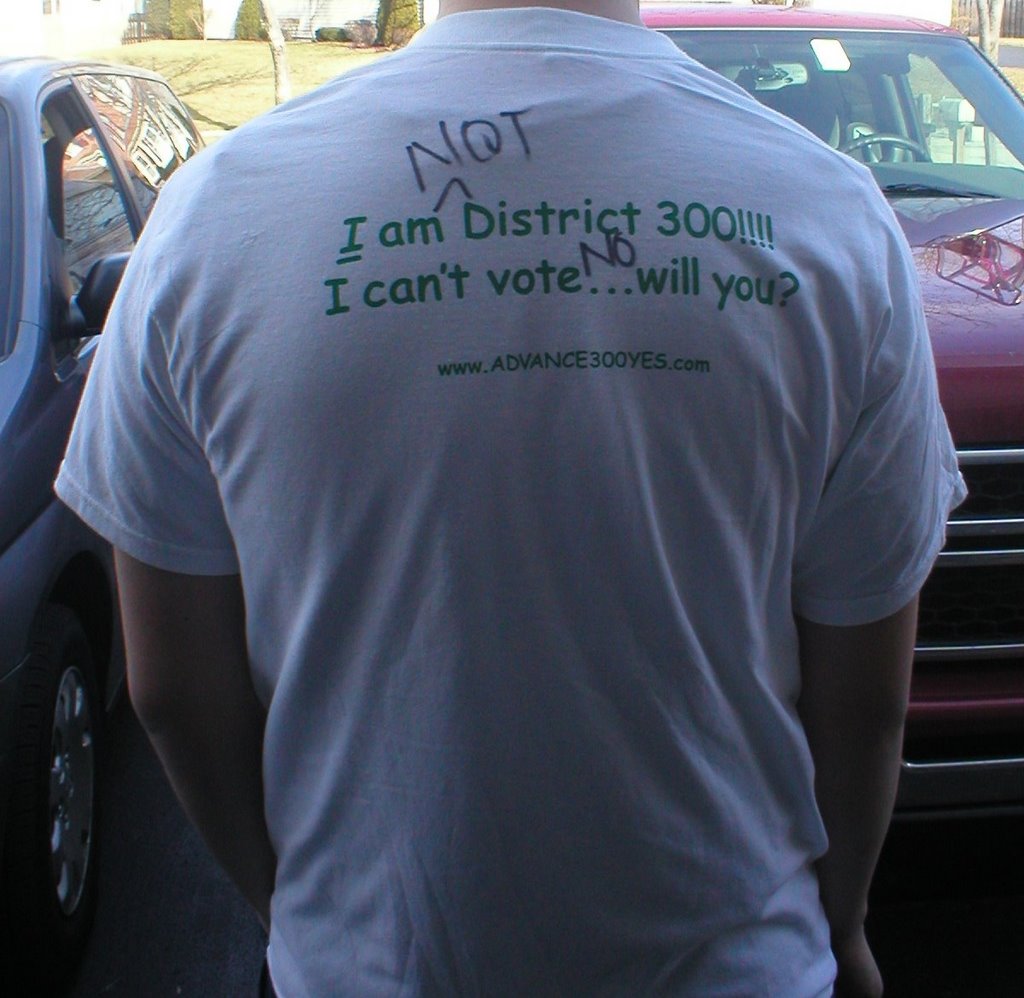

The following was sent to us by a Jacob's High School Student.
Hello, I am a student at Jacobs High School. Supposedly, and by law as well, schools including Jacobs, Dundee Crown, Westfield, and all other District 300 schools are not allowed to push for a yes,yes or no,no vote on March 21,2006's referenda questions. However, this has been ignored. Let me show you a (currently) typical day at Jacobs High School regarding the referendum:
1.Come to school, and around 7:15/7:20, an announcement comes on (with a teacher speaking) about how students should sign up for canvasing(walking door to door for referendum support). Today's message was along the lines of this: "Subliminal(repeated several times), come canvas for Jacobs and District 300."
2. During the morning announcements which run from 7:40-7:45, there is 9/10 chance that pro referendum "prodigy" Matthew Bishop will come onto the intercom for an "important announcement," telling us about how we should not stand idly by, and all at the same time, support his cause.
3.During our flex block lunch, an announcement comes onto the intercom to remind us to go to today(Friday's) pro-referendum meeting in the auditorium. In today's meeting, they signed up people for canvasing, gave out t-shirts, and gave out wristbands.
4.After the 2:41 release bell has sounded, Matt Bishop (today at least) comes on to yet again tell us of the referendum and how we should care.
The above mentioned are a day-to-day basis, however other such things occur as:
1. Pro referendum tshirts being worn by students
2. Pro referendum "Yes,Yes" posters are put onto school hallways
3. Students wear "I am District 300" wristbands
How is it possible for this referendum to occur if the pro-referendum side cannot simply abide by not local, but STATE law?
Just like I am, my friends are also sick of this bombardment of propaganda.
Homeschooling, sweet homeschooling
The following article is by Nathanael Blake a senior in college who although he does not yet have children has decided to homeschool his children.
Homeschooling, sweet homeschooling
By Nathanael Blake
Mar 10, 2006
Last week a New York Times article profiled the ordeal of academic applications: essays, interviews, application consultants, tuition of $10,000 a year or more, and the stress of separating families.
The article was about private preschools in New York City. The following is representative of the tribulations chronicled among well-heeled parents. "When Ms. Malloy, a federal prosecutor, applied for her twins, a boy and a girl, she asked her husband to write the application essay. "I was so nervous," she said, "and I'm someone who took the LSAT, who's written for the federal judiciary and in law review."
The family applied to four schools. "There's not a week that goes by that I don't regret that I didn't apply to three or four more," Ms. Malloy said. And so the hamster-wheel rat-race is now beginning at the ripe old age of two.
For me, reading this story increased my determination that if probability wins out and I marry and have children (I'm archaic enough to believe that to be the proper order), they will be homeschooled.
But though over one million children are homeschooled in America, there's a surprising amount of resistance to the idea, even from many who support other alternatives to the state schools (i.e. charter and private schools).
When I tell people about my plans for my (hypothetical) children, I invariably hear the same infratentorial objection, which is that they won't "socialize" properly.
No one ever tells me that homeschooling will stifle my children's academic ability.
The stereotype is quite the opposite: homeschoolers are smart but socially inept. There are, to be sure, examples of failed homeschooling, but its general record is better than the government's schools.
There are occasional comments about the difficulty of homeschooling.
To be sure, it takes sacrifice, and there are some families that cannot undertake the task. Yet what are we to make of the wealthy New Yorkers who send their toddlers to pre-schools with tuition higher than my university's? They aren't driven by necessity, but by the desire to get their children out of the home and out of the way. This begs the query: why have children if you don't want them to interfere with your life?
I think that the least parents can do is to match the Spartans and allow the kids to be raised at home for the first seven years. Longer is better--even through high school.
But the cry goes up that they must be socialized. In response, most homeschoolers point out the many activities available to them, from sports to music to church.
They're right: as homeschooling usually teaches more in less time, it leaves more time for both play and social activities. And I can attest that most of the long-term homeschoolers I know posses fine social abilities.
Nevertheless, this view concedes too much. Why do we even assume that modern schools are a healthy way to socialize a child and set a standard homeschooling must match? The socialization of our school system is profoundly anti-social. Edmund Burke wrote of civilization as a partnership "between those who are living, those who are dead, and those who are to be born." In the schools, society doesn't even consist of the various generations of the living.
The standard (though rarely articulated) definition of successful socialization is to "fit in" with a lot of immature little savages raised by television, video games, and the internet. Spending at least 35 hours a week, nine months of the year, with 20-30 kids of one's own age (with a harried adult supervising) is the antithesis of what is needed in order to learn how to function in society.
Give me the shut-in homeschoolers any day; from their family and their books, they will at least have some notion of life beyond their cohort and how to interact with it.
Enough with socialization; let us look at a case for homeschooling.
The strongest argument for homeschooling is the education that takes place in the public schools, or rather, the lack thereof. Reports on the sorry state of America's schools come out regularly, and it's always interesting to see how many spots we've fallen and what tiny nations (like Luxembourg and the Czech Republic) outscored us academically.
The problem isn't a lack of funding.
Rather, much of it is due to a fondness for egalitarian gestures. As Christopher Lasch observed, "Given the underlying American commitment to the integral high school – the refusal to specialize college preparation and technical training in separate institutions – make-work programs, athletics, extracurricular activities, and the pervasive student emphasis on sociability corrupted not merely the vocational and life-adjustment programs but the college preparatory course as well." People have varying intellectual abilities, and however much it may offend liberals, half the population is below average.
Some people are ready for college work in their early teens and others will never be ready for it, but the school system is largely incapable of adjusting for this. Despite the burgeoning popularity of AP classes and the like, the brightest intellects are still stymied by years of waiting for their peers to catch up. Furthermore, the notion that schooling equates to an education has diluted the currency of a degree, as higher education has become a certification program.
To read the rest of the story go to townhall.com
Homeschooling, sweet homeschooling
By Nathanael Blake
Mar 10, 2006
Last week a New York Times article profiled the ordeal of academic applications: essays, interviews, application consultants, tuition of $10,000 a year or more, and the stress of separating families.
The article was about private preschools in New York City. The following is representative of the tribulations chronicled among well-heeled parents. "When Ms. Malloy, a federal prosecutor, applied for her twins, a boy and a girl, she asked her husband to write the application essay. "I was so nervous," she said, "and I'm someone who took the LSAT, who's written for the federal judiciary and in law review."
The family applied to four schools. "There's not a week that goes by that I don't regret that I didn't apply to three or four more," Ms. Malloy said. And so the hamster-wheel rat-race is now beginning at the ripe old age of two.
For me, reading this story increased my determination that if probability wins out and I marry and have children (I'm archaic enough to believe that to be the proper order), they will be homeschooled.
But though over one million children are homeschooled in America, there's a surprising amount of resistance to the idea, even from many who support other alternatives to the state schools (i.e. charter and private schools).
When I tell people about my plans for my (hypothetical) children, I invariably hear the same infratentorial objection, which is that they won't "socialize" properly.
No one ever tells me that homeschooling will stifle my children's academic ability.
The stereotype is quite the opposite: homeschoolers are smart but socially inept. There are, to be sure, examples of failed homeschooling, but its general record is better than the government's schools.
There are occasional comments about the difficulty of homeschooling.
To be sure, it takes sacrifice, and there are some families that cannot undertake the task. Yet what are we to make of the wealthy New Yorkers who send their toddlers to pre-schools with tuition higher than my university's? They aren't driven by necessity, but by the desire to get their children out of the home and out of the way. This begs the query: why have children if you don't want them to interfere with your life?
I think that the least parents can do is to match the Spartans and allow the kids to be raised at home for the first seven years. Longer is better--even through high school.
But the cry goes up that they must be socialized. In response, most homeschoolers point out the many activities available to them, from sports to music to church.
They're right: as homeschooling usually teaches more in less time, it leaves more time for both play and social activities. And I can attest that most of the long-term homeschoolers I know posses fine social abilities.
Nevertheless, this view concedes too much. Why do we even assume that modern schools are a healthy way to socialize a child and set a standard homeschooling must match? The socialization of our school system is profoundly anti-social. Edmund Burke wrote of civilization as a partnership "between those who are living, those who are dead, and those who are to be born." In the schools, society doesn't even consist of the various generations of the living.
The standard (though rarely articulated) definition of successful socialization is to "fit in" with a lot of immature little savages raised by television, video games, and the internet. Spending at least 35 hours a week, nine months of the year, with 20-30 kids of one's own age (with a harried adult supervising) is the antithesis of what is needed in order to learn how to function in society.
Give me the shut-in homeschoolers any day; from their family and their books, they will at least have some notion of life beyond their cohort and how to interact with it.
Enough with socialization; let us look at a case for homeschooling.
The strongest argument for homeschooling is the education that takes place in the public schools, or rather, the lack thereof. Reports on the sorry state of America's schools come out regularly, and it's always interesting to see how many spots we've fallen and what tiny nations (like Luxembourg and the Czech Republic) outscored us academically.
The problem isn't a lack of funding.
Rather, much of it is due to a fondness for egalitarian gestures. As Christopher Lasch observed, "Given the underlying American commitment to the integral high school – the refusal to specialize college preparation and technical training in separate institutions – make-work programs, athletics, extracurricular activities, and the pervasive student emphasis on sociability corrupted not merely the vocational and life-adjustment programs but the college preparatory course as well." People have varying intellectual abilities, and however much it may offend liberals, half the population is below average.
Some people are ready for college work in their early teens and others will never be ready for it, but the school system is largely incapable of adjusting for this. Despite the burgeoning popularity of AP classes and the like, the brightest intellects are still stymied by years of waiting for their peers to catch up. Furthermore, the notion that schooling equates to an education has diluted the currency of a degree, as higher education has become a certification program.
To read the rest of the story go to townhall.com
Thursday, March 09, 2006
A version of HB750 rears it's ugly head. The education establishments greed never ends and they have the money to buy off both sides of the aisle.
The following was sent to us by Marily Rickert of Fair Tax Now.
I received an alert from my local chamber of commerce which says in part:
On Feb 23, 2005 state Rep. Renee Kosel submitted and is the Chief sponsor of HB 3460 cited as the Local Property Tax Reduction Act which empowers local school districts to propose 2% income tax for schools. This new 2% tax along with the existing 3% state income tax will result in raising our overall income tax burden by 67%.
The Bill provides for the corresponding reduction in property taxes to be temporary if more money is needed by the school district.
This new bill is bad news for privately-owned business owners who reside in a school district that enacts this bill. Corporations are excluded and not subject to this tax, thus making it difficult to compete with owners who reside in a district that does not enact this option against those who live in a district that did.
Marilyn Rickert
It's time to pass the FairTax!
Note: Kosel is a Republican(?) and has a primary challenge
I received an alert from my local chamber of commerce which says in part:
On Feb 23, 2005 state Rep. Renee Kosel submitted and is the Chief sponsor of HB 3460 cited as the Local Property Tax Reduction Act which empowers local school districts to propose 2% income tax for schools. This new 2% tax along with the existing 3% state income tax will result in raising our overall income tax burden by 67%.
The Bill provides for the corresponding reduction in property taxes to be temporary if more money is needed by the school district.
This new bill is bad news for privately-owned business owners who reside in a school district that enacts this bill. Corporations are excluded and not subject to this tax, thus making it difficult to compete with owners who reside in a district that does not enact this option against those who live in a district that did.
Marilyn Rickert
It's time to pass the FairTax!
Note: Kosel is a Republican(?) and has a primary challenge
Subscribe to:
Posts (Atom)